The Loneliness Epidemic

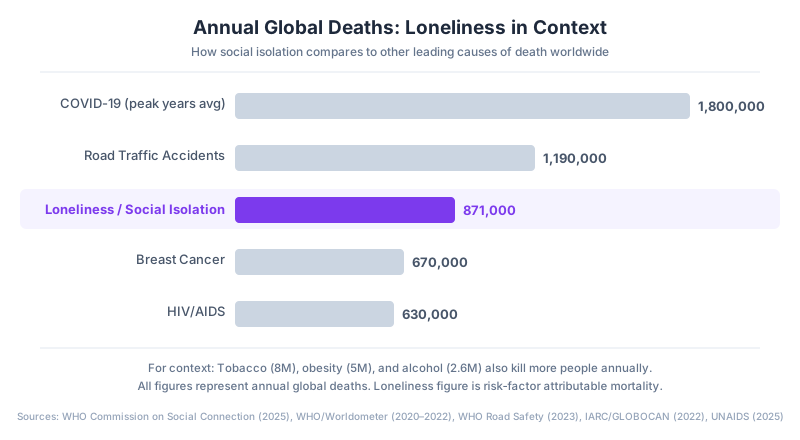
Loneliness is killing people. About 100 people every hour, according to the World Health Organization (WHO).
It may seem odd to think of loneliness as a life-threatening event, or an epidemic, but this is exactly what the U.S. Surgeon General declared in 2023. And in 2025, the WHO launched its Commission on Social Connection and the World Health Assembly adopted its first-ever resolution on social connection.
Loneliness is now thought to account for roughly 871,000 premature deaths per year, globally. That is more than the annual death toll of breast cancer, lung cancer, or car accidents in the United States --- combined.
Loneliness, unlike other recognized health crises, has a PR problem. The word "loneliness" still carries the faint scent of weakness. Of personal failure. Of something that happens to other people --- people who didn't try hard enough, who weren't interesting enough, who should just put themselves out there.
That framing is wrong. It is dangerous. And it is preventing us from responding to a health crisis with the seriousness it demands --- despite growing recognition by countries around the world of the economic and social toll of increased loneliness and isolation.
The Numbers
Let's start with the data, because the data is staggering.
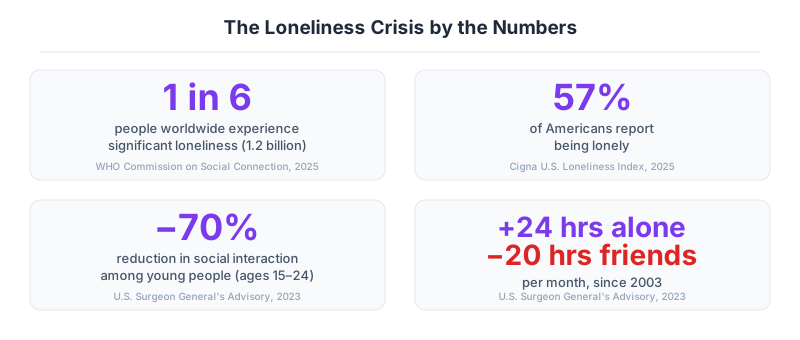
The WHO's Commission on Social Connection reports that one in six people worldwide --- roughly 1.2 billion human beings --- experience significant loneliness. Among young people aged 13 to 29, between 17% and 21% report feeling lonely. This is not an edge case. This is a defining condition of modern life.
In the United States, the picture is even starker. Cigna's 2025 survey found that 57% of Americans report being lonely. Not "sometimes a little isolated." Lonely. More than half the country.
The AARP's 2025 report, Disconnected, found that four in ten U.S. adults aged 45 and older are lonely --- up from 35% in both 2010 and 2018. The trend line is not ambiguous. It is not fluctuating around a mean. It is climbing.
And the behavioral data tells us why. Over the past two decades, young people aged 15 to 24 experienced a 70% reduction in social interaction with friends compared to their counterparts twenty years earlier. Across the broader population, time spent alone increased by 24 hours per month between 2003 and 2020. In that same period, time spent with friends declined by roughly 20 hours per month.
Read that again. Americans gained nearly an extra day per month of solitude and lost nearly an extra day per month of friendship. That is not a lifestyle choice. That is a structural collapse in the infrastructure of human connection.
This Is Not Just Feeling Sad
One of the most persistent barriers to treating loneliness as a health crisis is the assumption that it is purely an emotional experience --- unpleasant, sure, but not medical. Not something that belongs in the same conversation as heart disease or diabetes.
The research says otherwise, and it says it loudly.
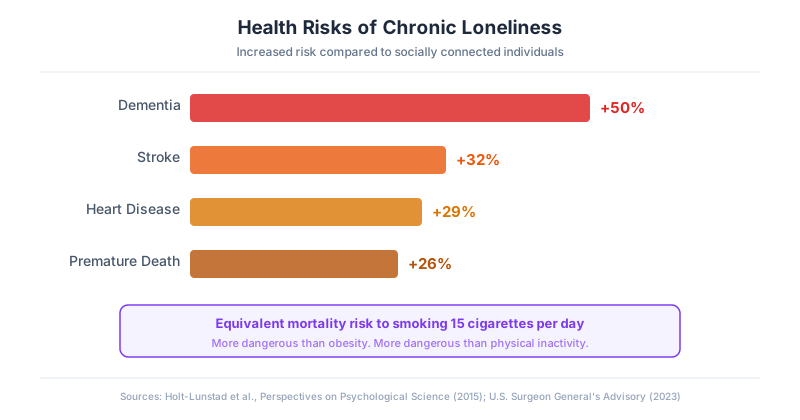
Loneliness is associated with a 29% increased risk of heart disease and a 32% increased risk of stroke. It carries a 50% increased risk of developing dementia and a 26% increased risk of premature death from all causes.
The statistic that gets cited most often, because it is the most viscerally jarring, comes from Julianne Holt-Lunstad's meta-analyses: chronic loneliness and social isolation carry a mortality risk equivalent to smoking 15 cigarettes per day. It is more dangerous than obesity. It is more dangerous than physical inactivity.
And the connections do not stop at physical health. Loneliness has bidirectional links with depression, anxiety, substance abuse, suicidal ideation, and cognitive decline. "Bidirectional" means the arrow points both ways: loneliness makes depression worse, and depression makes loneliness worse. The same is true for anxiety, for alcohol and drug use, for the kind of cognitive fog that makes it progressively harder to reach out, make plans, or maintain the connections that might actually help.
This is a health condition. It has measurable physiological effects. It damages the cardiovascular system, the immune system, and the brain. It shortens lives. Treating it as a mood is like treating hypertension as a feeling.
The Evolutionary Alarm
If loneliness is this destructive, why does it exist at all? Why would evolution preserve a response that causes so much damage?
The late neuroscientist Stephanie Cacioppo spent her career answering this question, and her framework reframes everything. Loneliness, Cacioppo argued, is a biological alarm system --- like hunger or thirst. It is not a disease. It is a signal.
"Loneliness alerts us to potential threats, and damage to our social body," she wrote. "It's the brain's way of telling you: You're in social danger."
For most of human history, social isolation was genuinely life-threatening. Humans survived in groups. Being separated from your group meant exposure to predators, starvation, and death. The pain of loneliness evolved to be intense --- as intense as physical pain --- because the stakes of isolation were that high.
The signal worked. When you felt lonely, you sought out your group. The pain resolved. The system was adaptive.
The problem is that our modern environment has broken the feedback loop. The alarm goes off, but the path back to meaningful connection is no longer clear. You cannot simply walk to the next campfire. The village does not exist in the same way. The alarm rings and rings and rings, and the chronic activation of this stress response --- the sustained flood of cortisol, the hypervigilance, the inflammatory cascade --- is what causes the health damage.
Loneliness is not a character flaw. It is a survival signal firing in an environment that has made it nearly impossible to respond to.
Who Is Actually Lonely
One of the most damaging misconceptions about loneliness is the image it conjures: an elderly person alone in an apartment, isolated by age and circumstance. That person exists, and their loneliness is real. But they are not the representative face of this crisis.
The highest rates of loneliness are found among young adults aged 18 to 25 and middle-aged adults in their late 40s through 50s. Not the demographics most people picture. Young adults are navigating a world with fewer structured social environments than any previous generation. Middle-aged adults are caught in the squeeze of caregiving, career demands, and the natural attrition of friendships that were never actively maintained.
People in romantic relationships get lonely. People with large social networks get lonely. You can be surrounded by others and still feel profoundly alone, because loneliness is not about the number of people around you. It is about the gap between the connection you need and the connection you have.
This is particularly acute for adults with ADHD. A large-scale survey by ADDitude Magazine found that 89% of ADHD adults report feeling lonely even when they are around other people. Not because they don't want connection. Not because they don't value their relationships. But because the neurological mechanisms that sustain connection --- working memory, consistent follow-through, emotional regulation, time awareness --- are precisely the ones that ADHD disrupts.
If you have ever thought about a friend, felt a wave of guilt for not calling, told yourself you would call tomorrow, and then not thought about them again for three months --- that is not a moral failure. That is a working memory deficit creating a pattern that looks, from the outside, like indifference. From the inside, it feels like something much worse.
The Neuroscience of Loneliness
Loneliness is not just an emotional state. It is a neurological one, and recent research is revealing how deeply it reshapes the brain.
A systematic review by Lam and colleagues (2021), published in Neuropsychopharmacology, examined 41 studies involving 16,771 adults. They found that lonely individuals show abnormal brain structure and activity in the prefrontal cortex and insula --- regions critical for social cognition, emotional processing, and self-awareness. Loneliness, in other words, is not just something you feel. It is something your brain does. It changes the hardware.
Even more striking is a 2023 study by Baek and colleagues, published in Psychological Science. Researchers used fMRI to examine how lonely and non-lonely individuals process the world. They found something remarkable: non-lonely people were similar to each other in their neural responses, processing social and emotional information in broadly comparable ways. Lonely people, by contrast, were dissimilar --- not just from non-lonely individuals, but from each other.
Lonely individuals, the researchers concluded, literally process the world in idiosyncratic ways. Each lonely person's brain has adapted to isolation differently, creating a kind of neural fingerprint of disconnection that is unique to them. This has profound implications for intervention. It means there is no single "fix" for loneliness, because loneliness is not a single neurological state. It is a family of states, each shaped by the specific history and biology of the person experiencing it.
This also helps explain why the advice to "just get out more" fails so consistently. If your brain is processing social information differently --- reading threat where there is none, misinterpreting neutral faces as hostile, struggling to sync with the social rhythms that come naturally to others --- then being placed in more social situations without addressing the underlying processing differences is like turning up the volume on a song you cannot hear.
Why It Is Getting Worse
Loneliness is not new. But its current scale and trajectory are. Understanding why requires looking at structural changes that have reshaped how humans live, work, and interact over the past several decades.
The decline of third places. Sociologist Ray Oldenburg coined the term "third places" for the public spaces --- coffee shops, barbershops, community centers, parks, places of worship --- where people gather informally, outside of home (first place) and work (second place). These spaces have been in decline for decades, replaced by drive-throughs, online shopping, and private consumption. Every shuttered community center is a node removed from the social graph.
Suburban sprawl. The built environment of much of America is designed for cars, not people. Cul-de-sacs and six-lane roads do not produce casual encounters. You cannot bump into a neighbor when everyone drives directly into their garage.
The transformation of work. Remote work, which accelerated dramatically during the pandemic, eliminated the workplace as a primary site of social interaction for millions of people. This is not an argument against remote work --- it has genuine benefits --- but it is an acknowledgment that one of the last remaining structured social environments in adult life was suddenly, for many people, gone.
Declining civic and religious participation. Whatever one thinks of organized religion or civic organizations, they provided structured, recurring, low-barrier social contact for generations. Their decline has not been matched by the rise of secular equivalents.
Social media. The relationship between social media and loneliness is more nuanced than the popular narrative suggests --- but the nuance does not exonerate the platforms. A 2025 study from Baylor University found that both passive and active social media use are associated with increased loneliness. This challenges the common assumption that passive scrolling is the problem while active posting and messaging are fine. The study suggests that social media may be displacing real connection regardless of how you use it.
None of these factors alone caused the loneliness crisis. Together, they have systematically dismantled the social infrastructure that previous generations relied on without ever naming. We removed the scaffolding and then blamed individuals for falling.
What the Surgeon General Proposed
The 2023 advisory did not just name the problem. It proposed a framework for response, organized around six pillars:
- Strengthen social infrastructure --- invest in the physical spaces and institutions that bring people together.
- Enact pro-connection public policies --- design transportation, housing, education, and workplace policy with social connection in mind.
- Mobilize the health sector --- train healthcare providers to assess and address loneliness as a health risk factor.
- Reform digital environments --- hold technology companies accountable for the impact of their products on social connection.
- Deepen knowledge --- fund research on loneliness, its causes, and effective interventions.
- Cultivate a culture of connection --- shift norms so that investing in relationships is seen as essential, not optional.
These pillars are sound. They represent a serious, evidence-informed framework for systemic change. If implemented, they would make a meaningful difference.
But they are also, by nature, institutional. They describe what governments, healthcare systems, and corporations should do. The crisis, however, is also deeply personal. It lives in the gap between knowing you should call your friend and not calling. It lives in the 2 a.m. scroll through contacts where every name triggers a small pulse of guilt. It lives in the question: Why is it so hard for me to do the thing I actually want to do?
Systemic change is necessary. But waiting for systemic change while people are suffering right now is not a plan. The question is: what actually works at the individual level?
What Actually Works
A landmark 2025 meta-analytic review, published in American Psychologist, synthesized 280 studies on loneliness interventions. The findings challenge much of the conventional wisdom about how to address loneliness.
The researchers categorized interventions into four types and measured their effectiveness:
- Psychological interventions --- primarily cognitive reframing, addressing maladaptive thoughts about social connection --- had the largest effect (effect size: -0.79).
- Social interaction-based interventions --- creating opportunities for social contact --- had a moderate effect (effect size: -0.50).
- Social support interventions --- providing ongoing support structures --- had a smaller effect (effect size: -0.34).
- Social skills training --- teaching people how to interact --- had the smallest effect.
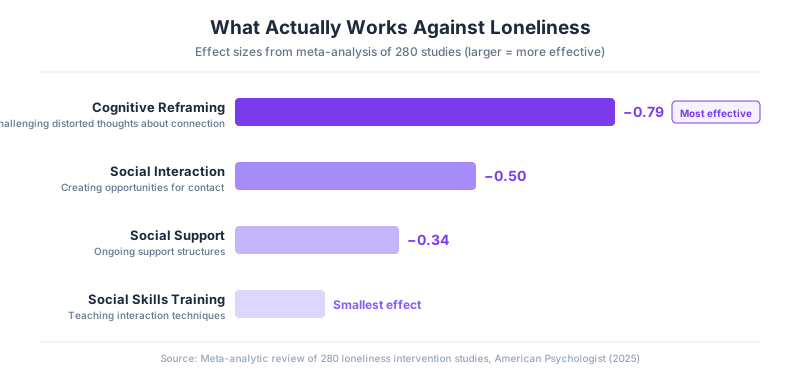
The hierarchy here is important. The most effective intervention is not providing more social opportunities. It is not teaching better social skills. It is changing how people think about connection.
This makes sense in light of the neuroscience. If loneliness reshapes how the brain processes social information --- making neutral faces seem hostile, making silence seem like rejection, making the absence of a text seem like evidence of abandonment --- then providing more social situations without addressing those distorted interpretations is treating the symptom while ignoring the cause.
Cognitive reframing means learning to challenge the automatic thoughts that loneliness generates. Thoughts like: They don't really want to hear from me. I've left it too long. I'm a burden. They're probably fine without me. I'm the only one who feels this way. These thoughts feel like facts. They are not facts. They are the loneliness alarm generating threat assessments that may have been adaptive on the savanna but are profoundly maladaptive in a world where your friend would actually be happy to hear from you.
This does not mean that social opportunities don't matter. They do. The meta-analysis shows they help. But they help more when combined with the internal work of recognizing and challenging the cognitive distortions that loneliness creates.
And this is especially relevant for people with ADHD, where rejection sensitive dysphoria amplifies those distorted threat assessments to an extraordinary degree. When "they didn't text back" triggers a physiological pain response indistinguishable from physical injury, the barrier to reaching out again is not social skill or social opportunity. It is the conviction --- felt in the body, not just the mind --- that reaching out will result in pain.
Understanding this is not a cure. But it is the beginning of one. Naming the distortion, recognizing its source, and learning --- slowly, imperfectly, with support --- to act despite it. That is the work.
Where We Go From Here
Loneliness is a crisis that requires both systemic and personal response. Both matter. Neither is sufficient alone.
At the systemic level, we need the investments the Surgeon General described: third places, pro-connection policy, healthcare integration, technology accountability, and a cultural shift that treats relationships as essential infrastructure rather than optional amenities. The WHO's new commission and the World Health Assembly's resolution are promising signals that the global health community is beginning to take this seriously.
At the personal level, we need to start by changing the story. Loneliness is not a character flaw. It is not evidence that you are unlikeable, or too much, or not enough. It is a biological signal --- as real and as morally neutral as hunger --- that has been chronically activated by an environment designed for efficiency, productivity, and individual consumption rather than for human connection.
If you are lonely, you are not broken. Your alarm system is working. It is telling you something true: that you need more meaningful connection than you currently have. The tragedy is not that the alarm is broken. The tragedy is that we have built a world where responding to it is so difficult.
The research tells us that the most powerful first step is not forcing yourself into more social situations --- though that can help. It is examining the thoughts that keep you isolated. The "it's been too long." The "they probably don't want to hear from me." The "I should have been a better friend." These thoughts feel protective. They are not. They are the walls that loneliness builds to sustain itself.
We are in the early stages of understanding loneliness with the seriousness it deserves --- as a health condition with neurological underpinnings, structural causes, and evidence-based interventions. We are late to this understanding, but we are not too late.
One in six people on this planet is lonely. One hundred people will die this hour from causes linked to social isolation. We have the research. We have the frameworks. We have, for the first time, global institutional attention.
What we need now is to treat this like what it is. Not a mood. Not a phase. Not a personal failing.
An epidemic.
References
-
U.S. Surgeon General. (2023). Our Epidemic of Loneliness and Isolation: The U.S. Surgeon General's Advisory on the Healing Effects of Social Connection and Community. U.S. Department of Health and Human Services. https://www.hhs.gov/surgeongeneral/reports-and-publications/connection/index.html
-
World Health Organization. (2025). Commission on Social Connection. https://www.who.int/groups/commission-on-social-connection
-
AARP. (2025). Disconnected: Loneliness Among Adults 45-Plus. AARP Public Policy Institute. https://www.aarp.org/pri/topics/social-leisure/relationships/loneliness-social-connections-2025/
-
Lam, J. A., Murray, E. R., Yu, K. E., Ramsey, M., Nguyen, T. T., Misber, J., Dowlati, N., Chen, W., Shen, D., & Azadi, A. (2021). Neurobiology of loneliness: A systematic review. Neuropsychopharmacology, 46(11), 1873--1887. https://pubmed.ncbi.nlm.nih.gov/34230607/
-
Baek, E. C., Hyon, R., Lopez, K., Finn, E. S., Porter, M. A., & Parkinson, C. (2023). Lonely individuals process the world in idiosyncratic ways. Psychological Science, 34(6), 683--695. https://journals.sagepub.com/doi/full/10.1177/09567976221145316
-
Baylor University. (2025). Social media's double-edged sword: Study links both active and passive use to rising loneliness. Baylor University News. https://news.web.baylor.edu/news/story/2025/social-medias-double-edged-sword-study-links-both-active-and-passive-use-rising
-
Holt-Lunstad, J., Smith, T. B., Baker, M., Harris, T., & Stephenson, D. (2015). Loneliness and social isolation as risk factors for mortality: A meta-analytic review. Perspectives on Psychological Science, 10(2), 227--237.
-
Are loneliness interventions effective? A meta-analytic review of 280 studies. (2025). American Psychologist. https://pubmed.ncbi.nlm.nih.gov/41129341/
-
ADDitude Magazine. The loneliest generation: ADHD and the epidemic of isolation. https://www.additudemag.com/isolation-withdrawal-loneliness-epidemic-adhd/
-
Cigna. (2025). The Loneliness Epidemic Persists: A Post-Pandemic Update. The Cigna Group.
-
UNAIDS. (2025). Global AIDS Update 2025 — Fact Sheet. https://www.unaids.org/en/resources/fact-sheet
-
International Agency for Research on Cancer. (2024). Global cancer statistics 2022 (GLOBOCAN). CA: A Cancer Journal for Clinicians. https://acsjournals.onlinelibrary.wiley.com/doi/10.3322/caac.21834
-
World Health Organization. (2023). Global Status Report on Road Safety 2023. https://www.who.int/news-room/fact-sheets/detail/road-traffic-injuries
Photos: Andri Kyrychok (header), john Applese, Fabrizio Azzarri, Anthony Tran, Apostolos Vamvouras via Unsplash. Used under the Unsplash License.
Stay in the Loop
New articles on money, health, and community — plus strategies for following through. No overwhelm, we promise.