Introducing Reconnect '26

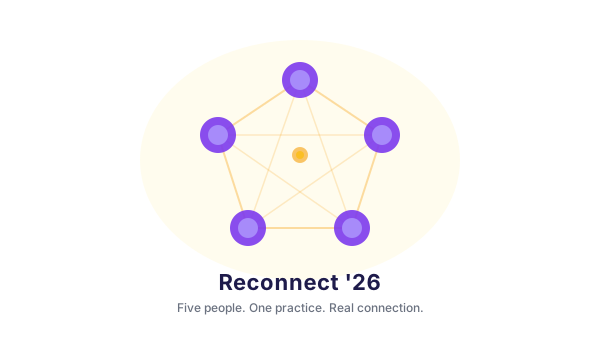
When it comes . You might not need to think hard to name them — a parent, a sibling, a best friend, someone who shaped who you are.
But when did you last really talk to them?
Not logistics. Not a quick text. An actual conversation — the kind where you hang up feeling lighter than before.
If it's been longer than you'd like, you're not alone. And you're not failing. You're experiencing something almost everyone experiences: the gap between how much you care and how often you connect.
What Reconnect '26 Is
Reconnect '26 is a practice. Not a challenge. Not a streak. Not a thing you can fail at.
It starts with a simple question: Who are the five people who matter most to me right now? And then a gentle commitment to stay connected to them — on purpose, not by accident.
That's it.
No app required. No daily check-ins. No scoreboard. Just the intention to close the gap, one conversation at a time.
Why Five
The number isn't arbitrary. Robin Dunbar, the anthropologist who discovered that human social networks naturally organize into layers, published new research in 2025 showing something remarkable: mental and physical health are best predicted by having about five close relationships. Not ten. Not twenty. Five.
These five people — Dunbar calls them your "sympathy group" — are the ones you'd turn to in a crisis. The ones who know what's actually going on in your life. You invest roughly 40% of your total social time in just these five people, even though your broader network might include hundreds.
The research also shows something counterintuitive: having more than five close relationships correlated with worse wellbeing, not better. The quality of your inner circle matters far more than the size of your network.
Five is enough. Five is the right number.
The Gap Is Normal
Here's what the science says about that guilt you feel when you realize it's been three months since you called your best friend:
People appreciate hearing from you more than you think. A 2023 study in the Journal of Personality and Social Psychology found that people systematically underestimate how much others appreciate unexpected contact. The longer it's been, the bigger the underestimate. That friend you're afraid to call because it's "been too long"? They'll be glad to hear from you.
You're probably undersocializing. Research from the University of Chicago shows that people consistently choose less social interaction than would actually make them happiest. We underestimate how good it feels to connect — before, during, and after. The barrier isn't desire. It's a miscalculation.
Old friendships retain trust. Even after years of silence, former close contacts retain what researchers call "residual trust" — the accumulated goodwill and shared history doesn't vanish. Dormant ties are dormant, not dead.
The gap between caring and connecting isn't a character flaw. It's a feature of busy modern life. Reconnect '26 is simply about narrowing that gap.
For Brains That Work Differently
If you have ADHD — or if you've ever described yourself as someone who "cares deeply but forgets to show it" — this might resonate especially hard.
ADHD brains face a specific challenge with relationships: out of sight often means out of mind. Not because the love fades, but because the mental reminder system doesn't fire. Three months feels like three weeks. The intention to call is real; the executive function to follow through is unreliable.
Then the gap grows. And with it, shame about the gap. And shame becomes avoidance. And avoidance becomes a longer gap. It's a cycle that has nothing to do with how much you care.
Reconnect '26 is designed with this in mind. No streaks to break. No guilt when you miss a week. Just a practice of returning, again and again, to the people who matter.
What's Coming
We're building tools to support this practice — gentle, ADHD-informed tools that help you remember the people you already care about. Not another social network. Not a CRM for your friendships. Something quieter than that.
We're also going to share what we're learning along the way — the research behind connection, the science of how relationships work, and practical ideas for closing the gap in your own life.
If any of this resonates, start here: think of one person you've been meaning to reach out to. Send them a message today. Not tomorrow. Today. It takes less than two minutes, and they'll appreciate it more than you'd guess.
That's the whole practice. Everything else is just support.
Photo: Steven Jones via Unsplash. Used under the Unsplash License.
Stay in the Loop
New articles on money, health, and community — plus strategies for following through. No overwhelm, we promise.
Related Articles
Getting Started with Emajon
A quick orientation for early testers — what Emajon is, how to navigate it, and why there's no wrong way to start.
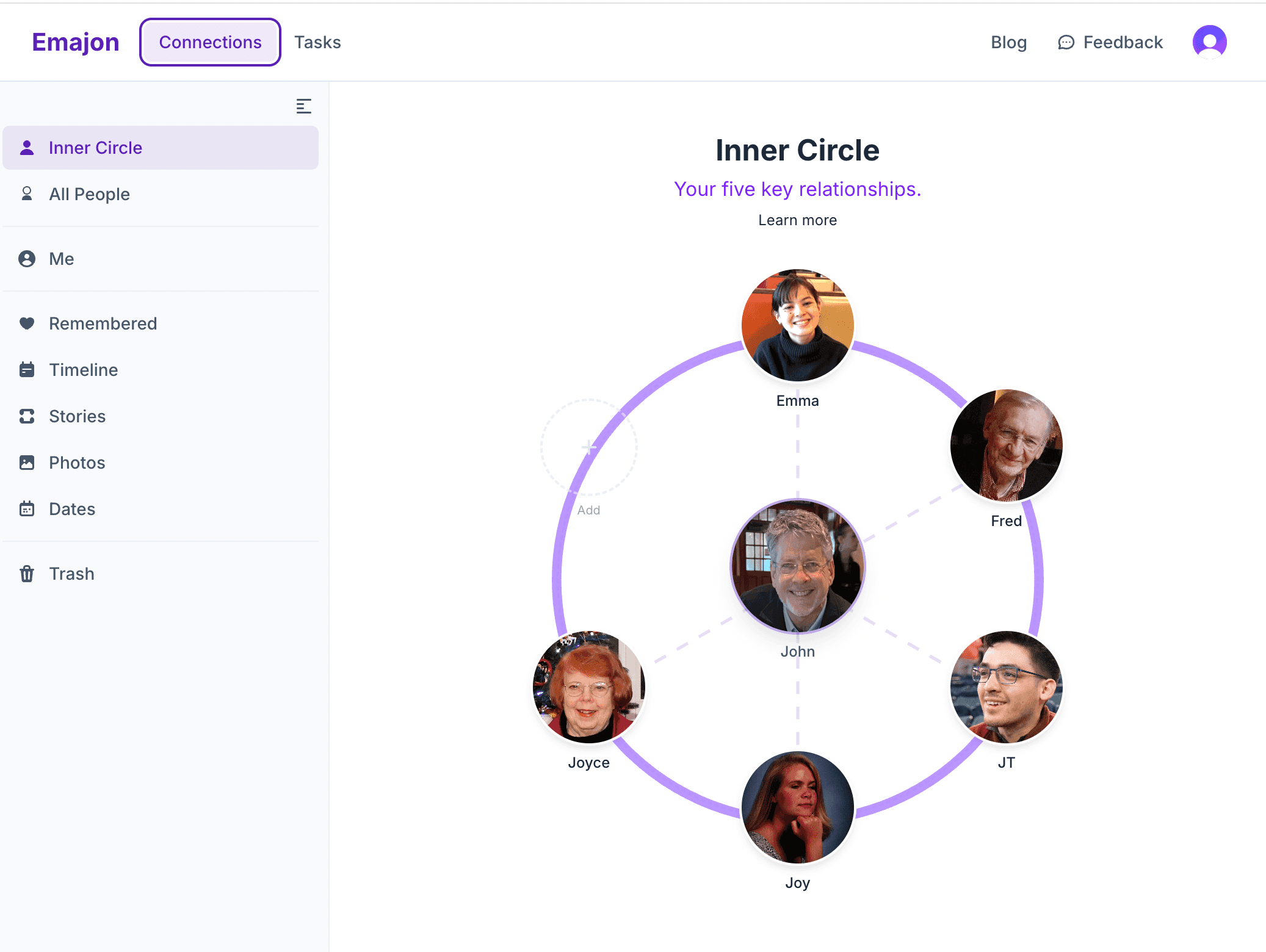
Your Five Key Relationships
How to use the Inner Circle in Emajon — adding people, enriching profiles, and the gentle nudges that help you stay connected.

The Science Behind Your Five
Why five relationships — not three, not ten — is the number that matters most for your health and happiness. A look at the research behind Reconnect '26.