The Science Behind Your Five

When we say Reconnect '26 is about "your five," that number isn't a marketing choice. It comes from decades of research in anthropology, psychology, and public health. Here's what the science actually says.
Your Brain Has Layers
In the 1990s, anthropologist Robin Dunbar discovered that human social networks aren't random — they organize into predictable layers that follow a consistent ratio of roughly three:
5 → 15 → 50 → 150 → 500 → 1,500
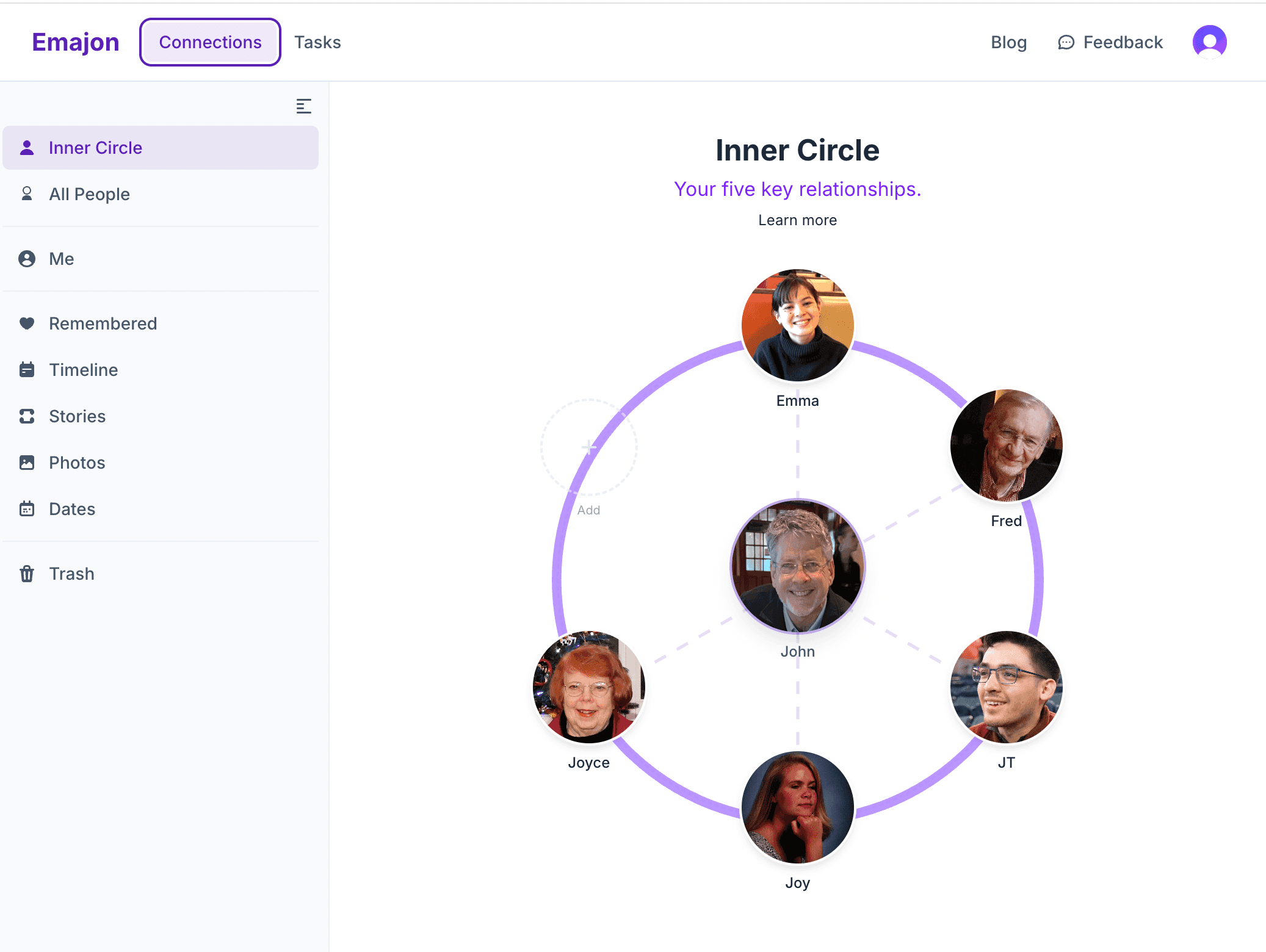
Your innermost layer of about 5 people is your sympathy group — the people you'd call in a crisis, who know what's really happening in your life. The next layer of 15 includes close friends. Then 50 good friends. Then 150 — Dunbar's famous number — the limit of people you can maintain a meaningful social relationship with.
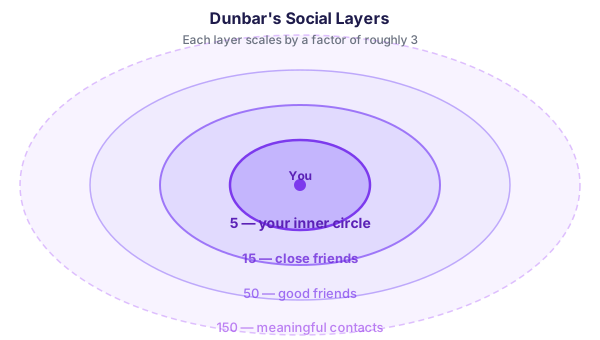
This structure isn't cultural. It appears consistently across societies, historical periods, and even in online social networks. It seems to be a constraint of our cognitive architecture — how many relationships our brains can genuinely maintain at different levels of intimacy.
Five Is the Health-Optimal Number
In 2025, Dunbar published new research in the Annals of the New York Academy of Sciences with a striking finding: mental and physical health and wellbeing are best predicted by having about five close relationships.
What makes this finding remarkable is that it's not just "more is better." People with fewer than five close relationships had worse outcomes — but so did people with more than five. The relationship between close friendships and wellbeing follows an inverted U-curve with the peak at five.
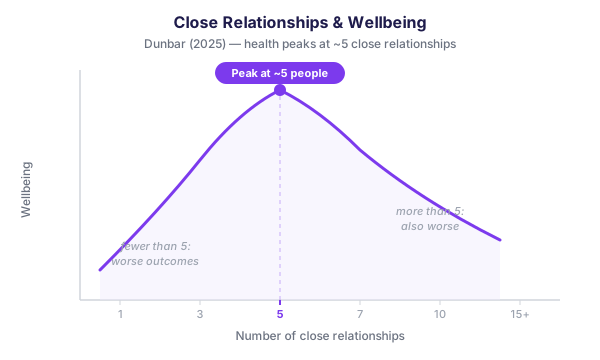
This makes sense when you consider the time investment involved.
The 40% Rule
Research by Sutcliffe and colleagues (2012) found that people invest approximately 40% of their total available social time in their top 5 relationships. Each person in your inner five receives about 8% of your social time. Each person in your outer 100? Less than half a percent.
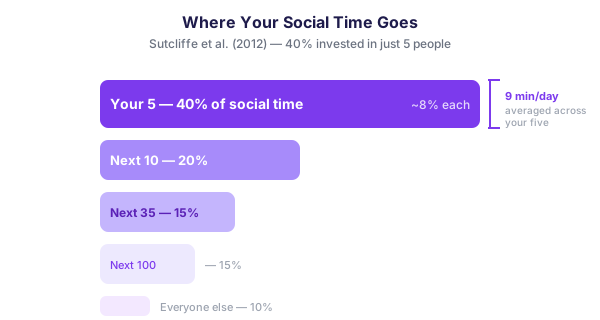
Maintaining a close relationship is genuinely expensive in terms of time and cognitive effort. There's a natural ceiling on how many relationships you can sustain at the highest level. Five isn't a limitation — it's the honest allocation of a scarce resource.
The Decay Curve
Here's where it gets urgent. Roberts and Dunbar (2011) tracked how relationships change when contact drops off, and they found a clear decay pattern:
- Weekly contact is needed to maintain your innermost relationships at their highest closeness level
- After about a month without contact, relationships begin to slip outward — from your inner 5 toward the next layer
- After roughly 100 days of silence, emotional connection is "effectively lost" — not destroyed, but migrated to an outer layer where it requires significant effort to rebuild
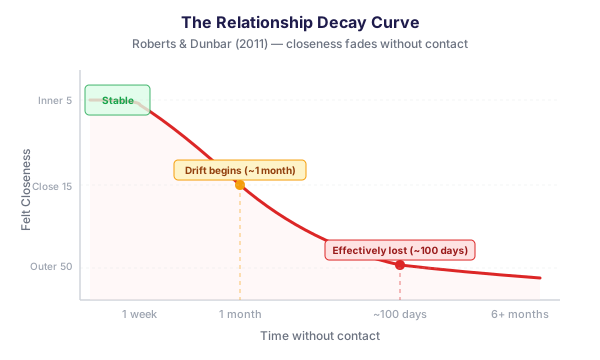
This decay happens regardless of how close you were. A thirty-year friendship and a three-year friendship follow the same curve. The relationship doesn't disappear — the accumulated trust and history remain — but the felt closeness fades.
This is why Reconnect '26 encourages regular, intentional contact rather than sporadic grand gestures. Small, frequent touchpoints maintain closeness far more effectively than occasional long conversations separated by months of silence.
They Want to Hear From You
One of the most consistent findings in social psychology is that people underestimate how much others appreciate hearing from them. Liu and colleagues (2023) showed that the longer it's been since you've been in touch, the more you underestimate how welcome your contact will be.
This creates a cruel irony: the longer the gap grows, the more you assume reaching out would be awkward — when in reality, the other person would appreciate it more, not less.
Boothby and colleagues (2018) documented a related phenomenon they called the liking gap: after conversations, people consistently underestimate how much the other person liked them and enjoyed the interaction. We are systematically miscalibrated about how positively others experience our company.
The shame barrier that keeps you from calling your friend? It's built on a distortion.
We're All Undersocializing
Kumar and Epley (2023) at the University of Chicago found something that reframes the whole conversation: people consistently choose less social interaction than would maximize their wellbeing. This isn't because people dislike socializing. It's because they underestimate its benefits.
In study after study, people predicted that social interactions would be less enjoyable than they actually were. They predicted they'd feel more awkward, that conversations would be harder, that the effort wouldn't be worth it. They were wrong almost every time.
This means the barrier to connection isn't about wanting it less. It's about needing better information: this matters more than you think it does, and it will feel better than you expect.
Connection as a Health Behavior
Julianne Holt-Lunstad's landmark meta-analyses (2010, 2015) established that weak social relationships carry a mortality risk equivalent to smoking 15 cigarettes a day, exceeding the risks of obesity, physical inactivity, and air pollution.
Strong social relationships increase survival likelihood by 50%. But critically, quality matters more than quantity. A few deep, reciprocal relationships are more protective than a large network of shallow ones. Having three thousand Instagram followers doesn't move the needle. Having five people who actually know you does.
This is why we frame connection as something you practice — like exercise or nutrition — rather than something that just happens. It's not that relationships should feel like a workout. It's that they benefit from the same intentionality we give to other things we know are good for us.
9 Minutes a Day
If you have five close relationships, and each one needs regular contact to stay close, how much time are we actually talking about?
Dunbar's research on time allocation suggests the answer is roughly 9 minutes per day — spread across your five, averaged over a week. Some days you'll have a long call with one person. Other days a quick text to another. The point isn't precision; it's that the actual time commitment is far smaller than people assume.
Nine minutes. That's less than most people spend scrolling social media while waiting for coffee. The investment is tiny. The return — in health, happiness, and the quality of your daily life — is enormous.
What This Means for You
You don't need to overhaul your social life. You don't need to become an extrovert. You don't need to host dinner parties or join clubs or optimize your social calendar.
You need five people. Regular contact. And the willingness to believe that they want to hear from you — because they do.
That's what Reconnect '26 is about. The science says it matters. The rest is just showing up. The focus at Emajon is to provide the information, tools, and techniques to help.
This post draws on research synthesized for the Emajon project. Key sources: Dunbar (2025, 2018), Sutcliffe et al. (2012), Roberts & Dunbar (2011), Holt-Lunstad et al. (2010, 2015), Liu et al. (2023), Kumar & Epley (2023), Boothby et al. (2018).
Photo: Hoi An and Da Nang Photographer via Unsplash. Used under the Unsplash License.
Stay in the Loop
New articles on money, health, and community — plus strategies for following through. No overwhelm, we promise.
Related Articles
Getting Started with Emajon
A quick orientation for early testers — what Emajon is, how to navigate it, and why there's no wrong way to start.
Your Five Key Relationships
How to use the Inner Circle in Emajon — adding people, enriching profiles, and the gentle nudges that help you stay connected.

Introducing Reconnect '26
Everyone has people who matter. Reconnect '26 is a practice — not a challenge — for closing the gap between how much you care and how often you connect.