Out of Sight, Out of Mind: How Working Memory Shapes Your Relationships
You're at a party, and you end up in one of those rare conversations that actually feels real. Not small talk. Not networking. You and this person are laughing, trading stories, discovering shared interests. There's a genuine spark of connection — the kind you don't find often enough.
You exchange numbers. Walking to your car, you think: I should text them this week.
Three months later, you're scrolling through your contacts looking for something else entirely, and you see their name. A wave of shame washes over you. You never texted. You didn't even think about it — not once — in ninety days.
And here's the part that makes it worse: it's not that you didn't care. You did care. You still care. If someone mentioned their name right now, you'd light up. "Oh, I really liked them!" The feeling is fully intact. What failed wasn't the caring. What failed was a very specific system in your brain — the one responsible for keeping things present in your awareness when you're not directly looking at them.
That system is called working memory. And if you have ADHD, it is almost certainly the single most important thing to understand about why your relationships look the way they do.
What Working Memory Actually Is
Think of your brain as having a desktop — not the physical kind with coffee rings and old mail, but the kind on a computer screen. Your mental desktop is the space where you hold everything you're actively thinking about right now. The conversation you're having. The thing you need to pick up at the store. The fact that your friend Sarah is going through a hard time.
This mental workspace is called working memory, and it does something remarkable: it keeps information alive and accessible even when you're not directly focused on it. It's the reason most people can hold a phone number in their head long enough to dial it. It's why you can follow a conversation while simultaneously remembering you left the stove on. It's the cognitive system that lets you juggle multiple pieces of information at once, maintaining awareness of things that matter even as your attention shifts from moment to moment.
Research suggests that the average person can hold roughly four to seven items in working memory at any given time. That's not a lot. Even for people with the most reliable working memory, it's a surprisingly small space. But here's what makes it powerful: for most people, the system runs reliably in the background. Items stay on the desktop until they're deliberately removed or replaced. Important things persist. The system quietly reminds you: hey, you haven't talked to Sarah in a while.
That background process — that quiet, automatic persistence — is what makes it possible to maintain awareness of the people in your life even when they're not standing in front of you.
How ADHD Changes the Desktop
Russell Barkley, one of the most influential ADHD researchers, places working memory at the center of his executive function model of ADHD. In Barkley's framework, ADHD is fundamentally a disorder of executive function — the brain's management system for planning, organizing, regulating emotions, and directing behavior toward goals. Working memory is a core component of that system, and in ADHD, it operates differently.
The desktop is smaller. Items don't stay put. Things slide off the edge without warning and without leaving a trace.
This isn't a metaphor for being scatterbrained or careless. It's a description of a specific cognitive system operating with reduced capacity and reliability. Neuroimaging studies consistently show differences in the prefrontal cortex — the brain region most associated with working memory — in people with ADHD. The hardware is different, and that produces different results.
What does this look like in practice? It looks like walking into a room with a clear purpose and forgetting why you're there. It looks like losing track of a thought mid-sentence. It looks like genuinely intending to do something important and then having that intention simply vanish from your awareness, as if it had never existed.
And it looks like the person you met at the party disappearing from your mind completely — not because you don't value them, but because your brain's system for keeping them visible is unreliable.
In the ADDitude Magazine survey of 4,170 adults with ADHD, 63 percent identified "poor working memory" as a root cause of their loneliness. That is a striking number, and it suggests that many people with ADHD have already intuitively identified the mechanism. They know this isn't about character. It's about capacity.
What This Means for Relationships
When someone is physically present — sitting across the table, in the same room, part of your daily routine — they occupy space on your desktop naturally. Their existence is reinforced by sensory experience. You see them. You hear them. They're there.
But the moment they leave your immediate environment, they become entirely dependent on working memory to remain in your awareness. And if your working memory is unreliable, here's the cascade that follows:
A friend is no longer physically present. They leave the room, you drive home, life continues. In a neurotypical brain, they remain on the desktop — a low-level awareness that Sarah exists, that she matters, that you owe her a call.
In an ADHD brain, they slide off the desktop. Not immediately and not every time, but consistently enough that it becomes a pattern. There's no malice in this. There's no decision. It's more like a file silently closing itself.
No internal reminder system fires. The quiet background process that would normally nudge you — hey, you haven't talked to Sarah — doesn't activate. Not because you don't care, but because the system that would generate that nudge relies on the very working memory that already dropped her.
Days become weeks become months. Without that internal prompt, there's no trigger to reach out. And because you're not aware she's slipped off your radar, you don't even know there's a problem to solve.
When you finally do remember, guilt has accumulated. Something triggers the memory — a mutual friend mentions her, you see a photo, you stumble on her name in your phone. And now you don't just feel the normal impulse to reconnect. You feel the weight of all the time that has passed. You feel like you've done something wrong.
Guilt makes reaching out harder. Now the text isn't just "hey, thinking of you." Now it feels like it requires an explanation. An apology. An account of where you've been. The cognitive and emotional cost of reaching out has multiplied.
More time passes. More guilt. The relationship atrophies. The longer you wait, the harder it gets. The harder it gets, the longer you wait. Eventually, the friendship that once felt effortless requires an act of emotional bravery to resume — and many people, weighed down by shame, simply never take that step.
This is the "out of sight, out of mind" cascade, and it is the most common pattern of friendship loss for adults with ADHD. Not fights. Not betrayals. Not growing apart. Just silence — driven by neurology and compounded by guilt.
This Is Not Forgetting
There's a crucial distinction to make here, because the phrase "I forgot about you" carries a devastating implication — that the person didn't matter enough to remember. That's not what's happening.
You haven't forgotten Sarah. If someone says her name, you immediately think: Oh, I love Sarah! How is she? The memory is intact. The affection is intact. Everything you know about her — how you met, what she cares about, the conversation you had last time — it's all still there, fully preserved in long-term memory.
What failed is not the storage system. What failed is the retrieval system — the mechanism that would spontaneously bring Sarah to mind without an external trigger. It's the difference between losing a file and losing the shortcut to it. The file is right where you left it. You just have no way to find it unless something — or someone — points you to it.
This distinction matters enormously, both for self-understanding and for explaining the experience to others. "I forgot about you" sounds like indifference. "My brain doesn't automatically remind me that you exist when you're not in front of me" sounds very different — because it is very different.
Time Blindness Compounds the Problem
ADHD doesn't just affect working memory. It also distorts the perception of time itself — a phenomenon researchers call time blindness.
For most people, the passage of time is felt intuitively. You have a rough internal sense of how long it's been since you did something. You know the difference between "a few days ago" and "a few months ago" without checking a calendar.
For people with ADHD, that internal clock runs unreliably. Subjective time and objective time come unmoored from each other. "Last week" might have been two months ago. "Recently" could mean six months. A conversation you feel like you just had may have taken place in a different season.
This compounds the working memory problem in a specific and painful way. Even when you vaguely sense that you should reach out to someone — a dim awareness that it's been a while — you don't realize how long it's actually been. You think you called your mom last week; it was three weeks ago. You feel like you texted your friend recently; it was before the holidays. The guilt that would normally motivate action doesn't fire, because your brain is telling you the gap is smaller than it actually is.
By the time you realize the true duration, the gap has grown large enough to trigger the guilt cascade. And the cycle continues.
The Neurotypical Misunderstanding
Here's where the real damage happens — not inside your own head, but in the space between you and the people you care about.
For people without ADHD, maintaining awareness of important people is largely automatic. It's a background process that runs without conscious effort, like breathing. They don't have to try to remember that their friend exists. The thought just appears: Haven't talked to Jamie in a while. Should give them a call.
Because this process is effortless and invisible, most neurotypical people don't even know it's happening. They assume everyone has it. It's like assuming everyone can see the color red — you wouldn't question it unless someone told you otherwise.
So when a friend with ADHD goes quiet for months, the neurotypical friend interprets it through their own cognitive framework. And in their framework, the only explanations for sustained silence are emotional ones:
They must not care about me.
They're avoiding me.
I must have done something wrong.
They've moved on.
Every one of these explanations is wrong, but every one of them is reasonable if you assume the other person's brain works like yours. The truth — that the friend literally lost the cognitive shortcut to their awareness — doesn't even register as a possibility, because the neurotypical person has never experienced anything like it.
This is the core misunderstanding that quietly destroys ADHD friendships. Not anger. Not conflict. Just two people operating with different neurological equipment and interpreting each other's behavior through the wrong lens.
Dunbar's Layers and the ADHD Desktop
In the 1990s, evolutionary psychologist Robin Dunbar proposed that human cognitive capacity limits the number of stable social relationships we can maintain to approximately 150. This "Dunbar's number" has since been confirmed across dozens of studies examining personal networks, historical communities, and even social media behavior.
What's more relevant here is the layered structure within those 150 relationships. Dunbar's research reveals concentric circles of decreasing intimacy: roughly 5 people in your innermost circle (your closest confidants), about 15 good friends, around 50 friends, and then the full 150 meaningful connections. Each layer requires a different frequency of contact to maintain, and each layer serves a different function in your social and emotional life.
A 2025 study published in PLoS ONE found that people perceive themselves as devoting substantially more energy toward inner layers than outer ones — and that the total "social bandwidth" is relatively fixed. Investing more in some relationships means investing less in others. This is true for everyone.
But here's the ADHD-specific challenge: if your working memory can only reliably maintain active awareness of a handful of people at any given time, even your inner circle can slip off the desktop. The person who should be in your top 5 — the person you genuinely love — can go months without contact because your brain's capacity to hold them in active awareness doesn't match your heart's capacity to care about them.
This creates a painful mismatch. You might have genuine capacity for 150 meaningful relationships — the warmth, the interest, the emotional depth. But your working memory can only actively maintain awareness of a few people at any given moment. The rest exist in a kind of cognitive storage — fully loved, but functionally invisible.
What Helps
If the problem is that working memory can't reliably keep people on your desktop, then the solution is to build external systems that do it instead. The technical term for this is externalizing the executive function — creating outside structures that perform the cognitive work your brain struggles with.
This is not a new idea. Previous generations did it naturally. Address books. Christmas card lists. Social calling schedules. Weekly phone calls on Sunday evenings. The church directory. The neighborhood drop-in. These were all, whether people recognized it or not, external systems for keeping relationships visible and maintaining regular contact.
What's changed isn't the need for these systems — it's the recognition that for ADHD brains, they're not a nice-to-have. They're essential. They're the difference between maintaining your relationships and watching them quietly disappear.
Here are strategies that work, grounded in how ADHD brains actually operate:
Make people physically visible. A photo on your desk. A card on the fridge. A printed picture taped to your bathroom mirror. Physical objects persist in your environment in a way that digital reminders don't. They catch your eye when you're not expecting it. They work because they don't require you to remember to check them — they're just there, putting people back on your desktop every time you glance in their direction. This is why a photo on your desk works differently than a contact in your phone. The photo doesn't wait for you to open it. It operates on you passively, without requiring any executive function at all.
Use recurring calendar events. "Text Sarah" every two weeks. "Call Mom" every Sunday. "Check in with college friends" on the first of the month. These are not romantic. They might feel mechanical. But they externalize the reminder function that your brain can't perform reliably on its own. The goal isn't to make connection feel automated — it's to make sure the prompt to connect actually fires, so the genuine warmth you feel can take over from there.
Tell people what's happening. This might be the most powerful strategy of all, and it costs nothing. Tell your friends: "I have ADHD, and people I love literally disappear from my active awareness. If I go quiet, it's not because I don't care. It's because my brain dropped the shortcut to you. Please don't take it personally, and please keep reaching out."
This kind of disclosure does two things. It prevents the neurotypical misunderstanding before it starts, and it gives the other person a framework for interpreting your silence that doesn't lead to hurt. Most people, when they understand the mechanism, respond with compassion rather than resentment.
Create low-friction rituals. The lower the barrier, the more likely you are to follow through. A voice memo is easier than a phone call. A "thinking of you" text is easier than a full catch-up. A reaction to someone's social media post is easier than composing a message. The research on relationship maintenance is clear: even minimal, infrequent contact can sustain a meaningful connection, as long as it's genuine. The bar is lower than you think.
Leverage physical artifacts. A handwritten note. A postcard. A small gift you spotted that reminded you of someone. Physical objects carry weight that digital messages don't. They communicate effort and care. And the act of writing or choosing something engages your brain differently than typing a text — it's more likely to stick, more likely to feel meaningful to both you and the recipient.
Why This Is the Most Important Thing to Understand
The "out of sight, out of mind" problem is not the most painful ADHD relationship challenge. That distinction probably belongs to rejection sensitive dysphoria — the intense emotional pain triggered by perceived rejection that can make every social interaction feel dangerous. RSD is visceral and immediate in a way that working memory failure is not.
But the working memory problem is the most mechanistic. It has the clearest neurological explanation, the most predictable pattern, and — critically — the most straightforward path to intervention. You cannot willpower your way to a larger working memory. But you can build external systems that compensate for it. You can tell the people you love what's happening. You can restructure your environment so that the people who matter stay visible.
Understanding this one mechanism — really understanding it, not as a character flaw but as a specific cognitive limitation with specific workarounds — can transform how you think about your friendships. It can replace shame with clarity. It can turn "I'm a terrible friend" into "My brain needs external support to do something that other brains do automatically." And from that reframing, everything else becomes possible.
The people you love haven't been forgotten. They've been waiting in a part of your mind that your working memory can't reach on its own. The task isn't to care more. You already care. The task is to build the bridges that bring them back into view.
References
- ADDitude Magazine. (2024). The Loneliest Generation: Survey of 4,170 adults with ADHD.
- Jong, A., Odoi, C.M., Lau, J., & Hollocks, M.J. (2024). Loneliness in Young People with ADHD: A Systematic Review and Meta-Analysis. Journal of Attention Disorders, 28(7), 1063-1081.
- Barkley, R.A. Executive function model and ADHD working memory research. See: Executive Functions: What They Are, How They Work, and Why They Evolved (Guilford Press).
- Dunbar, R. (2024). The social brain hypothesis — thirty years on. Annals of Human Biology.
- Reflecting on Dunbar's numbers: Individual differences in energy allocation to personal relationships. (2025). PLoS ONE.
- CHADD. Relationships & Social Skills.
- Healthline. ADHD and Friendships.
Stay in the Loop
New articles on money, health, and community — plus strategies for following through. No overwhelm, we promise.
Related Articles
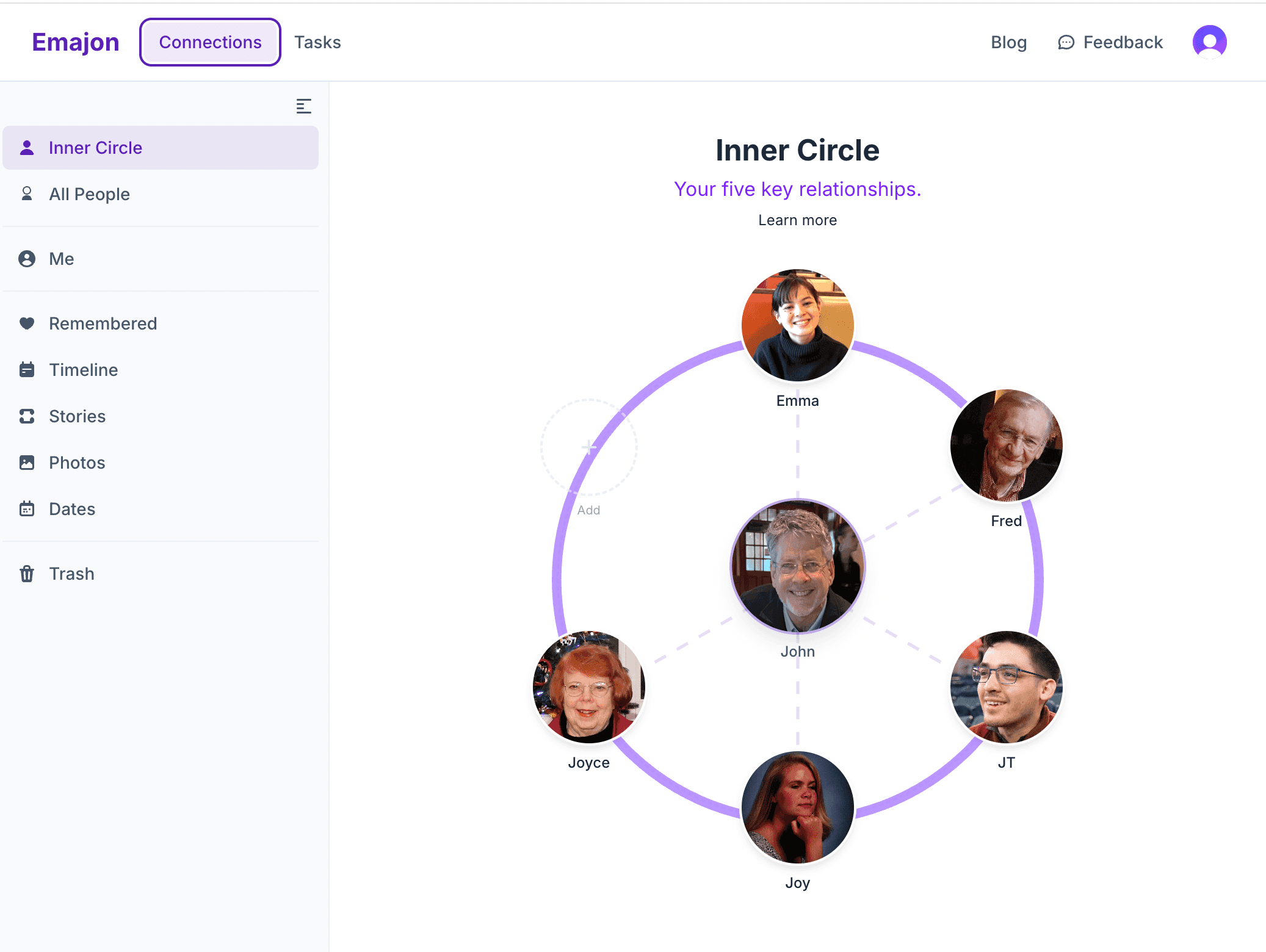
Getting Started with Emajon
A quick orientation for early testers — what Emajon is, how to navigate it, and why there's no wrong way to start.
Your Five Key Relationships
How to use the Inner Circle in Emajon — adding people, enriching profiles, and the gentle nudges that help you stay connected.

Introducing Reconnect '26
Everyone has people who matter. Reconnect '26 is a practice — not a challenge — for closing the gap between how much you care and how often you connect.