The ADHD Friendship Problem Nobody Talks About
Let me tell you about a pattern you might recognize.
You're lying in bed on a Sunday night, and your friend crosses your mind. Not just any friend -- a good one. Someone you genuinely care about. You think, I should really call Sarah. It's been a while.
Then a small, cold realization lands: it hasn't just been "a while." It's been four months. Four months since you last spoke. You didn't mean for that to happen. You weren't angry or distant or bored with the friendship. You just... didn't call. And now the guilt is so heavy that picking up the phone feels impossible. What would you even say? Hey, sorry I disappeared for a third of a year?
So you don't call. And another month passes. And the guilt compounds. And eventually the thought of Sarah stops surfacing at all, because your brain has quietly filed her away somewhere you can't easily reach.
If you have ADHD, this is probably not a hypothetical. This is probably Tuesday.
This pattern -- loving people deeply while simultaneously failing to maintain contact with them -- is one of the most painful and least discussed aspects of living with ADHD. It's not about being selfish. It's not about being a bad friend. It's about a specific set of neurological differences that make the maintenance mechanics of friendship genuinely difficult. And understanding those mechanics is the first step toward building something better.
The Scope of the Problem
Before we get into the why, let's talk about how widespread this is, because if you're living it, you should know you are far from alone.
ADDitude Magazine surveyed 4,170 adults with ADHD and the results were staggering. Nearly two-thirds of respondents ages 18 to 29 reported feeling lonely "always" or "often." That alone is striking -- but the next finding is the one that really cuts: 89 percent of these young adults said they feel lonely even when they are around other people. Being in a room full of friends doesn't fix it. Having coworkers and roommates doesn't fix it. The loneliness isn't about physical proximity. It's about a deeper sense of disconnection.
Only 19 percent said social media makes them feel more connected. The digital world, for all its promises, isn't bridging the gap.
The academic research confirms what the survey data suggest. In 2024, researchers at King's College London published the first meta-analysis specifically examining loneliness in young people with ADHD. Led by Angelina Jong and colleagues, the study reviewed 20 studies involving approximately 6,300 participants and was published in the Journal of Attention Disorders. The meta-analysis of 15 of those studies found that young people with ADHD reported significantly higher loneliness than their non-ADHD peers, with a small-to-medium effect size (Hedges' g = 0.41). When one outlier study was removed, the effect grew even larger (Hedges' g = 0.48). This held across age groups, genders, and recruitment settings.
Perhaps the most important finding: loneliness fully mediated the relationship between ADHD diagnosis and depression. In other words, loneliness appears to be a primary pathway through which ADHD leads to depression. It's not just that people with ADHD are sadder -- it's that the social disconnection caused by ADHD symptoms creates the conditions for depression to take root.
This is not a peripheral issue. This is central to the lived experience of ADHD.
Why This Happens: The Neurology
So why do people with ADHD struggle so much with friendship maintenance? The answer isn't a single factor -- it's a convergence of several neurological differences, each of which creates friction in a different part of the friendship process.
Working Memory: Out of Sight, Literally Out of Mind
Working memory is the cognitive system that holds information in active awareness -- the mental workspace where you keep track of what's happening right now and what you need to do next. In ADHD, working memory capacity is reduced. This has profound implications for relationships.
When a friend is physically in front of you, they exist in your awareness. You feel connected. You care. But the moment they leave the room -- and certainly once they leave your daily routine -- they can essentially disappear from your active mental workspace. This isn't forgetting that they exist. It's a failure of the system that keeps them present in your mind when they're not physically present.
Neurotypical brains do this automatically. A friend might cross your mind while you're driving, and you think, Oh, I should text them about that thing they mentioned. For the ADHD brain, that automatic surfacing happens less reliably. People you love can go weeks or months without appearing in your active awareness -- not because you don't care, but because your working memory isn't bringing them forward.
This is the "out of sight, out of mind" phenomenon, and it is the single most common ADHD friendship challenge. It is not a character flaw. It is a neurological difference with a specific mechanism.
Time Blindness: Where Did the Months Go?
People with ADHD often experience what researchers call "time blindness" -- a diminished internal sense of how much time has passed. There is no reliable internal clock telling you, It's been three weeks since you talked to Marcus. Instead, time compresses and stretches unpredictably. A week ago and three months ago can feel functionally identical.
This means that "I should get together with them soon" -- a thought that feels perfectly timely and reasonable -- might be occurring four months after your last interaction. You genuinely believe it was recent. It wasn't. And when you eventually check the dates, the gap between your perception and reality produces a sharp jolt of shame.
Time blindness also makes it nearly impossible to build rhythms of contact. Neurotypical adults might naturally fall into a pattern of catching up with a friend every few weeks. Without an internal sense of elapsed time, those natural rhythms never form. Each interaction exists in its own pocket of time, disconnected from the last.
Executive Function: The Engine That Stalls
Maintaining a friendship requires a cascade of executive function steps: remembering the person exists (working memory), deciding to reach out (initiation), figuring out how and when (planning), following through on the decision (execution), and managing the interaction itself (sustained attention, emotional regulation). Each step requires executive function, and ADHD impairs every single one of them.
Even when someone with ADHD successfully thinks about a friend and decides to reach out, they might get stuck at any point in the sequence. They think about calling but can't decide whether to call or text. They start composing a text but get distracted. They plan to meet up but can't coordinate the logistics. Each abandoned attempt adds a small layer of guilt.
Emotional Dysregulation: Feeling Everything at Full Volume
ADHD doesn't just affect attention and organization -- it affects emotional regulation. Emotions arrive faster, hit harder, and are more difficult to modulate. In the context of friendship, this can mean overreacting to a perceived slight, being overwhelmed by the emotional demands of social interaction, or avoiding vulnerable conversations because the emotional exposure feels unmanageable.
This is also where rejection sensitive dysphoria -- the intense emotional pain triggered by perceived rejection -- enters the picture. But more on that in a moment.
The Executive Function Skills Friendship Actually Requires
It's worth pausing to appreciate just how many executive function demands friendship places on a person. A 2024 narrative review published in Frontiers in Developmental Psychology examined why people with ADHD struggle to make and keep friends, identifying four interacting factors: ADHD symptomatology, executive functioning deficits, social cognition deficits, and emotion regulation difficulties. These aren't separate problems -- they compound each other.
Consider what maintaining a single friendship actually requires:
- Working memory -- Remembering details your friend shared with you. Their partner's name. The job interview they were nervous about. The fact that their mother is sick. Without this context, conversations feel shallow and the friend feels unseen.
- Time management -- Scheduling catch-ups, being on time, maintaining a rhythm of contact. Each of these requires a functional sense of time that ADHD disrupts.
- Planning and organization -- Coordinating plans, following through on commitments, preparing for social events. The logistics alone can be overwhelming.
- Emotional regulation -- Managing your reactions during disagreements, not overwhelming people with intensity, responding proportionally to situations.
- Impulse control -- Listening without interrupting, not oversharing, thinking before speaking. These require constant self-monitoring that drains cognitive resources.
- Sustained attention -- Active listening, following complex conversations, staying present. Zoning out mid-conversation isn't rudeness -- it's a symptom.
Now multiply all of that by every friendship you're trying to maintain. It is an enormous cognitive load, and it falls disproportionately on a system that is already strained.
The Shame Cycle
Here is where the problem becomes self-reinforcing. The neurological challenges create gaps in contact. The gaps create guilt. The guilt makes reaching out harder. The increased difficulty creates longer gaps. And the cycle accelerates.
One respondent to the ADDitude survey described this with devastating clarity:
"When I feel lonely, I want to reach out, but I usually don't because: (1) 'Out of sight out of mind' has left too much time between interactions, and I feel shame over this. (2) When no one reaches out to me, or if I reach out and get no immediate response, RSD kicks in and I'm immediately overwhelmed with self-loathing. (3) I dwell on each previous interaction and why this person may be harboring ill feelings toward me. (4) Depression asks, 'What's the point of interaction? It'll just exhaust you.'"
Read that again slowly. Each step is a separate mechanism -- working memory failure, rejection sensitive dysphoria, rumination, depression -- and they chain together into a cycle that feels inescapable. The person wants to connect. They ache for it. But every pathway toward connection is blocked by a different symptom.
This is the cruelest dimension of the ADHD friendship problem: it creates loneliness while simultaneously preventing the actions that would relieve it. You are lonely and unable to do the thing that would make you less lonely. And then -- because this isn't painful enough already -- society tells you that loneliness is a personal failing. That if you just "put yourself out there" or "made more of an effort," the problem would resolve. The implication is that you're not trying hard enough, when the truth is that you're trying enormously hard at something your neurology makes genuinely difficult.
The shame itself becomes a barrier. When enough guilt accumulates around a particular friendship, the thought of that person becomes associated with failure rather than warmth. Reaching out means confronting the gap, acknowledging the lapse, and risking the friend's reaction. For someone with rejection sensitive dysphoria, that risk feels enormous. So the friendship quietly dies -- not from lack of love, but from an accumulation of shame.
What ADHD Brains Bring to Friendships
It would be a mistake -- and an inaccurate one -- to frame this as a story of deficit alone. The same neurological differences that make friendship maintenance difficult also create qualities that make people with ADHD extraordinary friends.
CHADD (Children and Adults with Attention-Deficit/Hyperactivity Disorder) highlights several strengths that people with ADHD characteristically bring to their relationships:
- Spontaneity -- The impulse to say "let's go do something right now" creates moments of joy and adventure that planned interactions rarely match.
- Energy and enthusiasm -- When an ADHD brain is engaged, it is fully engaged. That intensity of presence is a gift.
- Creativity -- Novel ideas, unexpected connections, the ability to make mundane situations interesting.
- Deep empathy -- Many people with ADHD are intensely empathic, feeling others' emotions with an immediacy that creates profound connection.
- Humor -- The rapid-fire associative thinking that makes focus difficult also makes for genuinely funny, surprising conversation.
- Inclusivity -- Having experienced feeling "different," many people with ADHD are acutely sensitive to excluding others and go out of their way to include people.
The problem has never been that people with ADHD are bad at friendship. The problem is that they have specific gaps in the maintenance mechanics -- the behind-the-scenes executive function work that keeps a friendship alive between the moments of genuine connection. When two people are together, the relationship thrives. The challenge is everything that happens between those moments.
We are not broken. We have strengths that are genuine and specific challenges that are also genuine. Addressing the challenges doesn't diminish the strengths -- it lets them show up more often.
What Actually Helps
Understanding the neurology matters because it points toward specific, practical workarounds. These are not miracle cures. They are small adjustments that reduce the friction between wanting to maintain friendships and actually doing it.
Externalize the Memory
If your working memory won't reliably surface your friends, build a system that does it for you. Write things down. Use a calendar to schedule "reach out to [friend]" reminders. Keep a list of people you care about in a place you see regularly. The goal is to create an external trigger that compensates for the internal one that isn't firing.
This is not cold or calculating. It is the relationship equivalent of setting an alarm because you know you'll lose track of time. It is self-knowledge put into practice.
Lower the Bar
You do not need to have a two-hour phone call to maintain a friendship. A text that says "Hey, thinking about you" takes fifteen seconds and keeps the thread alive. A reaction to their social media post. A meme that reminded you of them. A voice memo sent while walking the dog.
The biggest enemy of ADHD friendship maintenance is the all-or-nothing trap: the belief that if you can't do it "properly" (a long call, a planned dinner, a meaningful catch-up), it's not worth doing at all. That belief is wrong. Low-effort contact is real contact. It counts. Send the text.
Name It
One of the most powerful things you can do is tell your friends what's happening. "I have ADHD, and one of the ways it shows up is that I disappear from people's lives sometimes. It's not because I don't care about you -- it's a working memory thing. If I go quiet, it's not about you."
This does two things. First, it removes the ambiguity for your friend. They don't have to wonder whether you're upset with them or have lost interest. Second, it gives you permission to reach out after a gap without the crushing weight of having to explain yourself each time. The explanation has already been given.
Many people with ADHD are afraid that naming it will sound like an excuse. In my experience, the opposite is true. Friends are almost universally relieved to understand the pattern. They'd rather know it's ADHD than wonder if they did something wrong.
Build Structure
Ad hoc plans are the enemy of ADHD friendship. "We should get together sometime" is a promise that will almost never convert to action, because it requires initiation, planning, and follow-through at a later date -- exactly the executive function sequence that ADHD disrupts.
Recurring structures bypass this problem. A standing weekly coffee. A monthly game night that's always the first Friday. A seasonal tradition. These work because they remove the need to initiate and plan each time. The decision has already been made. You just have to show up.
If you can't build recurring structures, try piggybacking on existing ones. Meet a friend at the gym you already go to. Invite someone to the grocery run you're already making. Embed social contact into routines that are already established.
Forgive Yourself
This might be the most important one. The guilt you carry about friendships you've neglected is not helping those friendships. It is, in fact, the thing most actively harming them -- because it makes reaching out harder, not easier.
You are going to have gaps. You are going to forget. You are going to think about someone and then get distracted before you text them. This will happen because you have ADHD, and ADHD affects exactly the cognitive systems that friendship maintenance depends on. That is not a moral failure. That is a neurological reality.
Forgiving yourself is not the same as giving up. It's clearing the shame that blocks action so that you can try again. And again. And again. Each time from a starting point of self-compassion rather than self-punishment.
Closing: You Are Not a Bad Friend
If you've read this far and seen yourself in these descriptions, I want to say something clearly: you are not a bad friend. You are a person with a brain that works differently, navigating a set of social expectations that were designed for neurotypical executive function.
The loneliness you feel is not a punishment for your failures. It is a signal -- your brain telling you that something important is missing. And the gap between your desire for connection and your ability to maintain it is not a character flaw. It is a specific, identifiable, neurological challenge with specific, identifiable workarounds.
Understanding the mechanism is the first step. Once you can see that the problem is working memory, not caring. Time blindness, not indifference. Executive function, not effort. Once you can name the shame cycle and recognize rejection sensitive dysphoria when it shows up. Once you can separate what your brain is doing from who you are -- the path forward becomes clearer.
It won't be perfect. The gaps will still happen. But they can happen less often, and they can happen without the crushing weight of shame that makes them permanent.
Your friends are probably less upset than you think. Research consistently shows that people underestimate how much others appreciate unexpected contact. That friend you haven't called in four months? They'll be glad to hear from you. The gap matters less than you fear.
You are not a bad friend. You are a good friend with a brain that needs some help with the logistics. And that is an entirely solvable problem.
References
Jong, A., Odoi, C.M., Lau, J., & Hollocks, M.J. (2024). Loneliness in Young People with ADHD: A Systematic Review and Meta-Analysis. Journal of Attention Disorders, 28(7), 1063-1081. https://pmc.ncbi.nlm.nih.gov/articles/PMC11016212/
ADDitude Magazine. The Loneliest Generation: ADHD and the Loneliness Epidemic. https://www.additudemag.com/isolation-withdrawal-loneliness-epidemic-adhd/
Frontiers in Developmental Psychology (2024). Why can't we be friends? Challenges of making and keeping friends for children and adolescents with ADHD: A narrative review. https://www.frontiersin.org/journals/developmental-psychology/articles/10.3389/fdpys.2024.1390791/full
CHADD. Relationships & Social Skills. https://chadd.org/for-adults/relationships-social-skills/
CHADD. Being Social and Making Friends as an Adult with ADHD. https://chadd.org/adhd-news/adhd-news-adults/being-social-and-making-friends-as-an-adult-with-adhd/
ADDitude Magazine. Rejection Sensitive Dysphoria and ADHD. https://www.additudemag.com/rejection-sensitive-dysphoria-adhd-emotional-dysregulation/
Healthline. ADHD and Friendships: How to Nurture Your Relationships. https://www.healthline.com/health/adhd/adhd-and-friendships
Stay in the Loop
New articles on money, health, and community — plus strategies for following through. No overwhelm, we promise.
Related Articles
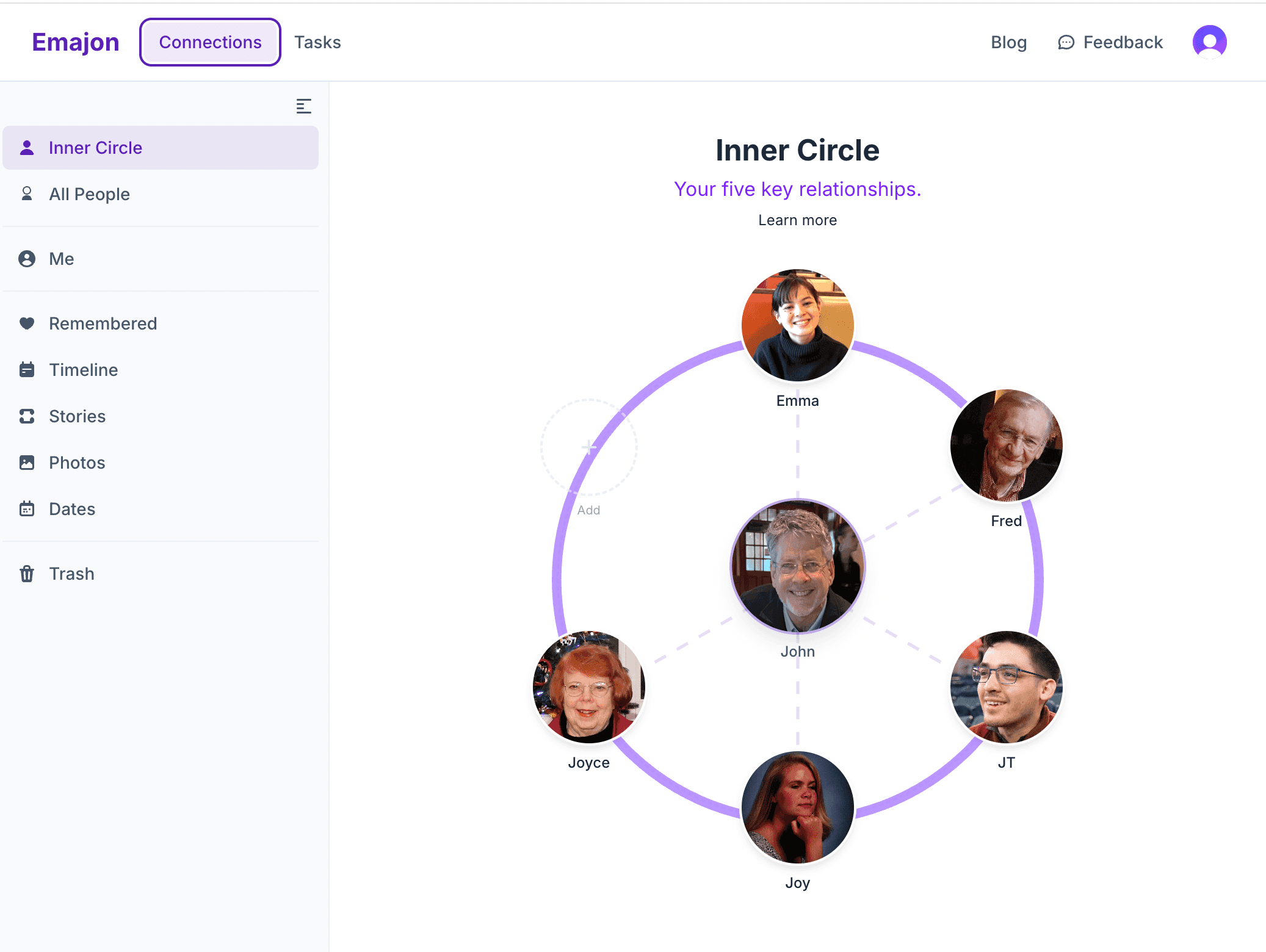
Getting Started with Emajon
A quick orientation for early testers — what Emajon is, how to navigate it, and why there's no wrong way to start.
Your Five Key Relationships
How to use the Inner Circle in Emajon — adding people, enriching profiles, and the gentle nudges that help you stay connected.

Introducing Reconnect '26
Everyone has people who matter. Reconnect '26 is a practice — not a challenge — for closing the gap between how much you care and how often you connect.