The ADHD Guilt Spiral: From "I Should Call" to "It's Been Too Long"
The Spiral
It starts with a thought. A warm one.
Day 1: I should text Jamie. Genuine impulse. Genuine intention. You saw something that reminded you of them, or their name floated through your mind unprompted, carried on a current of real affection. You mean it. You will do it.
But you are in the middle of something. Or you are about to leave the house. Or your phone is in the other room. The thought drifts off your mental desktop like a sticky note caught in a breeze.
Day 3: Oh right, I was going to text Jamie. I'll do it tonight. Still feels manageable. A small "oops," easily corrected. Tonight, you tell yourself. Definitely tonight.
Tonight comes and goes. You never sat down and thought, "I have decided not to text Jamie." The thought simply did not resurface at a moment when your hands were free, your energy was adequate, and nothing else was competing for your attention. Which, if you have ADHD, is most moments.
Week 2: I still haven't texted Jamie. I should really do that. A faint hum of guilt enters the picture. Not yet painful, but present. A small weight you carry without examining too closely.
Week 4: It's been a month. Now it's weird if I just text out of nowhere. I should probably call instead. And here is where the spiral begins to tighten. The bar has been raised. A simple text -- the thing that would have been perfectly fine on day one -- now feels insufficient. Your guilt has decided that the length of silence demands a proportional response. A longer message. A phone call. An explanation.
Week 6: I can't just call after six weeks of silence. I'd need to explain where I've been. Why I disappeared. That sounds exhausting. The task has transformed. What began as a two-second impulse -- hey, thinking of you -- has become, in your mind, a complex social repair operation requiring emotional labor you do not have. Avoidance kicks in. Not because you do not care, but because the caring itself has made the task feel impossibly heavy.
Month 3: I'm a terrible friend. Jamie probably thinks I don't care. It's been so long now that reaching out would just be awkward for both of us. The guilt has calcified into paralysis. The internal narrative has shifted from "I should reach out" to "I can't reach out." And underneath that, quieter and more corrosive: I don't deserve to.
Month 6 and beyond: Jamie's name in your contacts list, their face in your social media feed, triggers a wave of shame so familiar you barely notice it anymore. The relationship is dying -- not from a fight, not from a betrayal, not from a single harsh word -- but from the accumulated weight of unmade phone calls and unsent texts, each day adding another gram of guilt until the weight feels immovable.
Jamie has become a source of shame, not warmth. And you have lost someone who matters to you without either of you doing anything wrong.
You Are Not Alone in This
If you recognized yourself in that timeline, you are in overwhelming company.
This exact spiral is the single most commonly reported friendship pattern among adults with ADHD. In a survey of 4,170 adults conducted by ADDitude magazine, respondents described the cycle with painful clarity. One person captured it in four devastating sentences:
"When I feel lonely, I want to reach out, but I usually don't because: (1) 'Out of sight out of mind' has left too much time between interactions, and I feel shame over this. (2) When no one reaches out to me, or if I reach out and get no immediate response, RSD kicks in and I'm immediately overwhelmed with self-loathing. (3) I dwell on each previous interaction and why this person may be harboring ill feelings toward me. (4) Depression asks, 'What's the point of interaction? It'll just exhaust you.'"
That is the spiral in four steps, laid bare. Working memory failure. Shame. Rejection sensitivity. Resignation.
The survey found that for more than three-quarters of respondents, loneliness is tied directly to ADHD symptoms and their downstream effects. The numbers paint a picture of a problem that is pervasive, multi-layered, and deeply neurological:
- 67% cite low self-esteem as a root of their loneliness
- 65% cite rejection sensitive dysphoria (RSD)
- 64% cite social anxiety
- 63% cite poor working memory
- 59% cite masking -- the exhausting performance of being "normal"
- 57% cite executive dysfunction
These are not six different problems. They are six interacting forces that converge in the guilt spiral, each one making the others worse.
Anatomy of the Spiral: What Is Actually Happening at Each Stage
The guilt spiral feels like a moral failure. It is not. It is a cascade of specific, identifiable neurological and psychological mechanisms. Understanding what is happening at each stage does not make the guilt disappear, but it can loosen its grip.
Stage 1: The Dropped Thought
The intention to reach out is genuine. The affection is real. But in an ADHD brain, working memory -- the cognitive system that holds information in active awareness and keeps it available for action -- is impaired. Russell Barkley's influential model of ADHD describes it as fundamentally a disorder of executive function, with working memory deficits at its core. Thoughts, intentions, and plans do not stick the way they do in a neurotypical brain. They surface, they are real, and then they sink again beneath the noise of whatever is happening right now.
This is not about caring. A person who thinks "I should text Jamie" cares about Jamie. The thought itself is proof of that. The failure is not in the feeling. It is in the bridge between feeling and action -- a bridge that ADHD erodes at the neurological level.
Stage 2: The Accumulating Gap
Time blindness is one of the most disorienting features of ADHD. The internal clock that tells neurotypical people "it has been a while since you talked to Sarah" does not sound a reliable alarm in ADHD brains. Days become weeks without registering. The gap between "I was going to text Jamie" and "it has been a month" does not feel like a month. It feels like a vague, shapeless "recently." And by the time the gap becomes visible, it already feels too large.
Stage 3: The Raised Bar
Here is where guilt begins to distort the task. On day one, a two-word text -- hey, thinking of you -- would have been perfect. More than enough. But by week four, guilt has rewritten the requirements. Now you need to explain the silence. You need to call, not text. You need a reason for reaching out, not just the impulse. You need to apologize before you can connect.
The minimum viable action keeps getting more complex, more demanding, more emotionally costly. And this escalation is entirely internal. Jamie has not raised the bar. Your guilt has.
Stage 4: The Avoidance Response
The task has transformed. What was once "send a quick text" has become "navigate a complex emotional conversation that requires planning, courage, and energy." And complex tasks trigger ADHD avoidance. This is not laziness. It is a well-documented executive function response: when a task feels overwhelming, the ADHD brain routes around it. The bigger the task feels, the more powerfully the brain avoids it. And since the guilt is making the task feel bigger every day, the avoidance gets stronger every day too.
Stage 5: RSD Takes Over
Now the narrative shifts. From "I should reach out" to "they probably don't want to hear from me."
Rejection Sensitive Dysphoria -- the experience of intense emotional pain triggered by perceived rejection -- provides a self-protective rationalization for the avoidance. It is not that you cannot reach out, your brain tells you. It is that they do not want you to. They have noticed the silence. They are hurt. They have moved on. They have decided you are a bad friend, and they are right.
This feels like a conclusion. It feels like clear-eyed realism. But it is actually a defense mechanism. RSD is generating a story that justifies the avoidance, because the alternative -- reaching out and risking actual rejection on top of all this guilt -- feels unbearable. As the Cleveland Clinic notes, RSD is not a formal clinical diagnosis but is increasingly recognized as a significant feature of ADHD that makes perceived rejection feel like physical pain. When a simple text message carries the perceived risk of that kind of pain, of course you do not send it.
Stage 6: Shame Replaces Connection
This is the final stage, and the cruelest. The person's name no longer triggers warmth. It triggers guilt. Seeing them on social media brings a wave of shame. Their birthday notification on your phone is not a reminder to celebrate someone you care about -- it is an indictment. A reminder of everything you have not done.
The relationship has been converted from a source of joy to a source of pain. And this conversion happened without a single actual negative interaction between the two of you.
The Cruelest Part
At no point in this spiral did anyone do anything wrong.
You did not have a fight with Jamie. Jamie did not reject you. Nobody said anything hurtful. Nobody was cruel or careless or unkind. The entire relationship degraded through inaction, driven by a neurological difference in working memory and emotional regulation.
And yet the guilt feels as heavy as if you had deliberately caused harm. As if you had chosen, consciously, to abandon someone who trusted you. The shame carries the weight of intentional betrayal, when what actually happened is that your brain dropped a sticky note.
This is what makes the guilt spiral so destructive. It assigns moral weight to a neurological event. It treats a working memory failure as a character failure. And then it uses that shame to block the very action -- reaching out -- that would resolve everything.
Why "Just Text Them" Does Not Help
You have heard this advice. You may have given it to yourself, lying awake at 2 a.m. with Jamie's name pulsing in your conscience like a bruise. Just text them. What's the big deal? Just do it.
The advice is technically correct. A text would help. But by the time the spiral has progressed to stage four or beyond, "just text them" is not a simple action. It is at least five executive function demands stacked on top of each other:
- Overcoming shame -- You have to push through the guilt that has been building for weeks or months. This requires emotional regulation, one of the core deficits in ADHD.
- Deciding what to say -- Your brain insists you cannot just say "hey." You need to explain, apologize, justify. Planning what to say requires working memory and cognitive flexibility.
- Managing the fear that they will be cold or hurt -- RSD is screaming that this will go badly. Managing that fear requires emotional regulation again.
- Following through on the intention -- Actually picking up the phone, opening the app, typing the words, hitting send. This requires executive function and impulse to action.
- Handling whatever response comes -- What if they are distant? What if they are hurt? What if they do not respond at all? Bracing for the emotional aftermath requires yet more emotional regulation.
That is five separate executive function demands for one "simple" action. For an ADHD brain already depleted by weeks or months of guilt -- because guilt itself is cognitively expensive, consuming working memory and emotional bandwidth -- this is not simple at all. It is an executive function marathon disguised as a two-second task.
Telling someone deep in the guilt spiral to "just text them" is like telling someone with a broken leg to "just walk it off." The instruction identifies the right destination. It completely ignores the obstacle.
Breaking the Spiral -- At Each Stage
The guilt spiral is not inevitable. It has specific stages, and each stage has specific interventions. The key is matching the intervention to where you actually are, not where you wish you were.
At Stages 1-2: The Dropped Thought and the Growing Gap
Act on the impulse immediately. When you think of someone, text them right then. Not "later." Not "tonight." Not after you finish what you are doing. Now. Pull out your phone mid-sentence if you have to. The impulse is the reminder, and it may not come again.
This is backed by research. A series of studies by Peggy Liu, Kate Min, and colleagues (building on Zhao and Epley's earlier work on reaching out) found that people consistently underestimate how much others appreciate being contacted, especially when the contact is unexpected. Your friend will be glad to hear from you. The research is clear on this.
The message does not need to be elaborate. "Hey, thinking of you" with no follow-up plan is enough. A meme. A photo that reminded you of them. A single emoji reaction to their Instagram story. Any signal of life keeps the connection alive and prevents the gap from growing.
If you struggle to act immediately, lower the friction as much as possible. Keep your most important contacts pinned at the top of your messaging app. Create a shortcut on your home screen. Remove every barrier between the thought and the action, because for an ADHD brain, even one extra step can be the difference between doing it and losing the thought.
At Stage 3: The Raised Bar
Lower the bar deliberately. Your guilt is telling you that the gap demands a proportional response -- a long message, a phone call, an apology. Your guilt is wrong.
You do not need to explain the gap. You do not need to call instead of text. You do not need to apologize before connecting. The gap is not a debt you have to repay before you are allowed to be a friend again.
A meme is enough. A "miss you" is enough. A thumbs-up on their latest post is enough. Any signal of life. The bar your guilt has raised is imaginary. Knock it back down to where it was on day one.
At Stage 4: The Avoidance Response
Name what is happening. Say it out loud or write it down: "I am in the guilt spiral. My brain is making this bigger than it is. The task is a text message. My brain has turned it into a federal case."
Sometimes just recognizing the pattern breaks its power. The spiral thrives on being invisible, on masquerading as rational thought. When you drag it into the light and call it what it is -- an ADHD avoidance response to an artificially inflated task -- it often shrinks back to its actual size.
At Stage 5: RSD Has Taken Over
Reality-test the narrative. Your brain is telling you, "They probably don't want to hear from me." Ask yourself: what is the actual evidence for that? Not the feeling. Not the story your RSD has constructed. The evidence.
Usually, there is none. No angry message. No unfollowing. No sign whatsoever that Jamie is anything other than a person living their life who has not heard from you in a while.
And the research points in the opposite direction. Zhao and Epley's work found that people significantly underestimate how much others appreciate unexpected contact. They found that the more surprised the recipient was to hear from someone, the more they appreciated it. Your guilt says the gap makes reaching out worse. The data says the gap makes reaching out more meaningful.
At Stage 6: Shame Has Taken Root
This is where external help matters most. When shame has fully replaced warmth, it is very difficult to break the spiral alone. The shame feels like truth. It has been there so long it feels like part of the landscape.
Tell someone. A partner, a therapist, another friend. Say the words out loud: "I have been avoiding reaching out to Jamie because too much time has passed and now I feel terrible about it." Saying it out loud often reveals how solvable the problem actually is. A therapist can help you separate the neurological event (dropped thought) from the moral narrative (terrible friend). A partner or friend can sometimes just hand you the phone and sit with you while you type.
Research on loneliness interventions consistently shows that psychological approaches -- changing how you think about social connection -- are the most effective interventions available, significantly outperforming approaches that simply try to increase social contact. The guilt spiral is, at its core, a cognitive distortion. It can be addressed the way cognitive distortions are addressed: by naming it, examining the evidence, and deliberately choosing a different response.
The Truth About the Gap
Let us return to the research one more time, because it directly addresses the core lie the guilt spiral tells.
Zhao and Epley, in a series of experiments published in the Journal of Personality and Social Psychology, studied what happens when people reach out to someone they have not been in contact with for a while. They found something that should be posted on the wall of every ADHD person's bedroom:
The longer it had been since last contact, the more the recipient appreciated hearing from the sender.
Read that again. Your guilt says the gap makes reaching out worse. The research says the exact opposite. The gap makes it matter more. Not less. More.
The recipients in these studies were not annoyed. They were not cold. They were not keeping a tally of the days of silence. They were, overwhelmingly, happy. "It's so good to hear from you" was the consistent response, not "Where have you been?"
Your brain has been lying to you about what is on the other side of that text message.
A Permission Slip
If you need someone to tell you it is okay, here it is:
You can reach out after any amount of time. One month, six months, a year, five years. There is no expiration date on caring about someone.
You do not have to explain why you went quiet. You do not owe anyone an accounting of your executive function failures. "Hey, I've been thinking about you" is a complete and sufficient message at any point on any timeline.
If you want to, you can name it. "I have ADHD and sometimes I disappear -- it is never because I stopped caring." Most people will understand. Many will be relieved. Some will say, "Me too."
The other person has probably not been counting the days. They have their own life, their own worries, their own gaps in communication with people they care about. The gap is bigger in your head than in theirs. The shame is louder in your chest than in their memory.
And if you are worried that you need to make up for the silence with some grand gesture -- a long letter, an elaborate explanation, a perfectly crafted message -- stop. A two-word text is enough. A meme is enough. A heart emoji on a six-month-old photo is enough. Any signal of life is better than perfect silence.
For the Friends on the Other Side
If you have a friend with ADHD who disappears, please hear this: their silence is almost never about you.
It is not that they forgot you. It is that their brain's working memory system failed to keep you on the active desktop -- and then guilt about that failure created a wall they could not climb over. They thought about you. Probably many times. Each time, the thought came with a stab of shame that made it harder, not easier, to reach out.
Their guilt about the silence might be the very thing preventing them from breaking it.
Your "I miss you" text might be the lifeline that breaks the spiral. It removes the hardest part -- the initiation -- from their plate. It signals that you are not angry, not keeping score, not waiting for an apology. It tells them the door is still open.
Do not wait for them. Do not keep score. Do not interpret the silence as a message about your worth in their life. Just reach out. The research says they will be more grateful than you expect.
The Spiral Ends Where It Began
The guilt spiral is the most common way ADHD brains lose friendships. Not through conflict. Not through betrayal. Not through any of the dramatic ruptures we associate with relationship loss. Through the slow, quiet accumulation of unmade phone calls and unsent texts, each day adding another gram of guilt until the weight feels immovable.
But here is what the spiral does not want you to know: the weight is an illusion. It is your brain's guilt, not the other person's judgment. The wall between you and Jamie is made of shame, not stone. And shame dissolves the moment you act.
You can pick up the phone at any point in the spiral, and the most likely response -- the response the research predicts, the response thousands of people in this exact situation have received -- is: "It's so good to hear from you."
Think of your Jamie right now. You know who they are. Their name surfaced in your mind before you even finished reading this sentence.
Send the text. Right now. Before the thought drifts off the desk again.
It does not have to be perfect. It just has to exist.
References
- ADDitude Magazine. "The Loneliest Generation." Survey of 4,170 adults with ADHD. https://www.additudemag.com/isolation-withdrawal-loneliness-epidemic-adhd/
- Zhao, X., & Epley, N. (2022). "Surprisingly Happy to Have Heard from You: Misunderstanding the Impact of Reaching Out to Others." Journal of Personality and Social Psychology. (See also: Liu, P., Min, K., et al., extending this line of research.)
- Jong, A., Odoi, C.M., Lau, J., & Hollocks, M.J. (2024). "Loneliness in Young People with ADHD: A Systematic Review and Meta-Analysis." Journal of Attention Disorders, 28(7), 1063-1081. https://pmc.ncbi.nlm.nih.gov/articles/PMC11016212/
- Barkley, R.A. Executive Functions: What They Are, How They Work, and Why They Evolved. Guilford Press. (Foundational model of executive function deficits in ADHD.)
- Cleveland Clinic. "Rejection Sensitive Dysphoria (RSD)." https://my.clevelandclinic.org/health/diseases/24099-rejection-sensitive-dysphoria-rsd
- ADDitude Magazine. "Rejection Sensitive Dysphoria and ADHD." https://www.additudemag.com/rejection-sensitive-dysphoria-adhd-emotional-dysregulation/
- CHADD. "Relationships & Social Skills." https://chadd.org/for-adults/relationships-social-skills/
- Faraone, S.V., et al. (2023). "Evidence of emotion dysregulation as a core symptom of adult ADHD." PLoS ONE. https://journals.plos.org/plosone/article?id=10.1371/journal.pone.0280131
Stay in the Loop
New articles on money, health, and community — plus strategies for following through. No overwhelm, we promise.
Related Articles
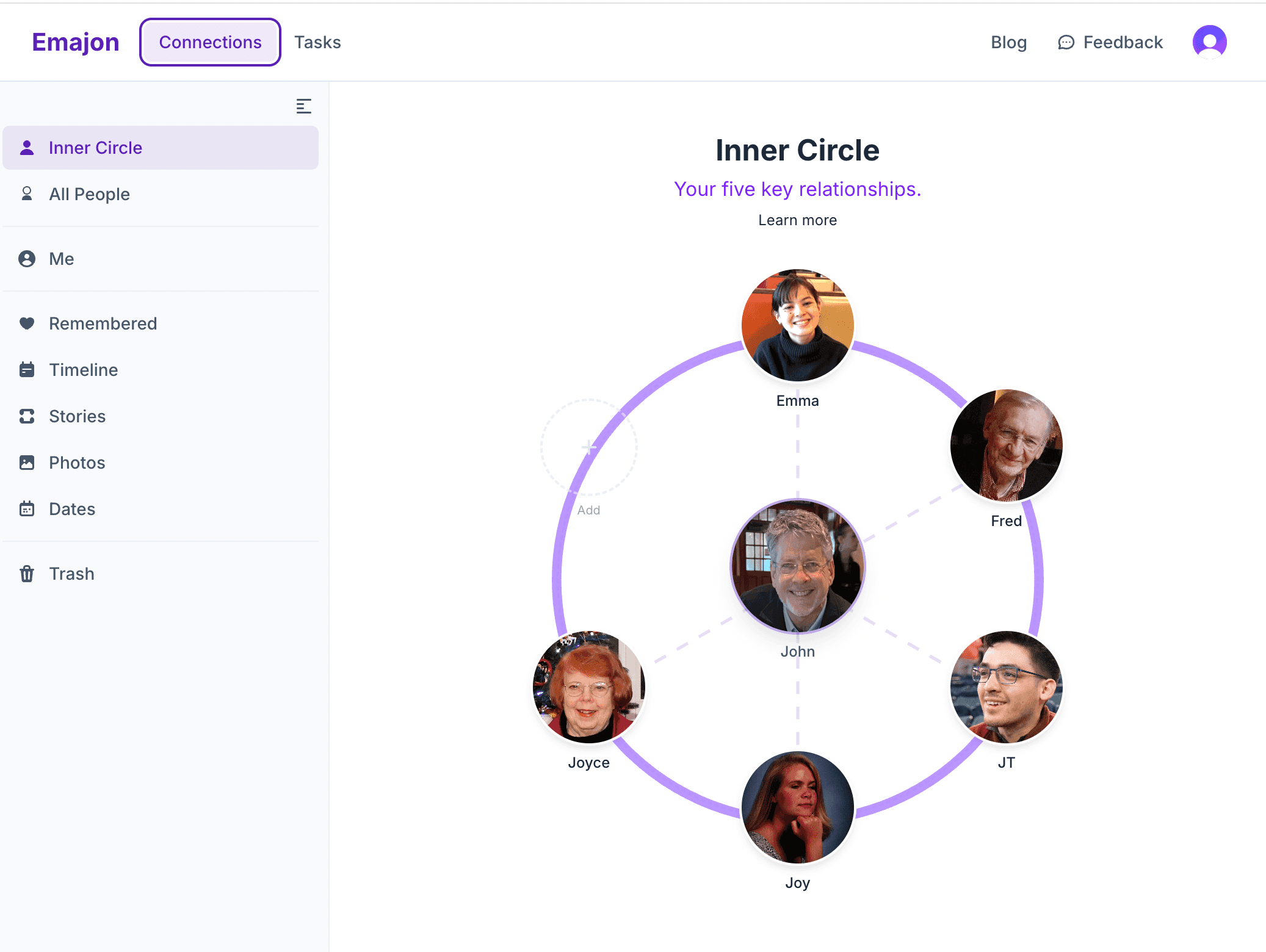
Getting Started with Emajon
A quick orientation for early testers — what Emajon is, how to navigate it, and why there's no wrong way to start.
Your Five Key Relationships
How to use the Inner Circle in Emajon — adding people, enriching profiles, and the gentle nudges that help you stay connected.

Introducing Reconnect '26
Everyone has people who matter. Reconnect '26 is a practice — not a challenge — for closing the gap between how much you care and how often you connect.