The Minimum Viable Friendship: What It Actually Takes to Maintain a Connection
You haven't called your friend in three months. Maybe four. You've thought about them — genuinely, warmly, with real affection — at least a dozen times. You even started a text once, then deleted it because you couldn't figure out the right thing to say after so long.
So now you're sitting with two feelings at once: you miss them, and you feel guilty for missing them without doing anything about it. The guilt is starting to calcify into something heavier — a quiet conviction that you're just not good at this. That you're a bad friend. That the silence has gone on too long and reaching out now would be awkward, or worse, unwelcome.
Here's what I want to tell you, as clearly as I can:
The bar for maintaining a friendship is so much lower than you think.
You don't need weekly dinners. You don't need daily texts. You don't need perfectly planned outings or marathon catch-up calls. Research — actual, peer-reviewed, replicated research — suggests that even minimal, infrequent contact can sustain a meaningful relationship. As long as it's genuine.
That text you deleted? It would have been enough.
The Friendship Maintenance Myth
Somewhere along the way, our culture developed an unspoken standard for what "good friendship" looks like: Good friends talk regularly. They make plans. They show up consistently. They remember birthdays without being reminded. They respond to texts within a reasonable timeframe. They initiate. They follow up. They are available.
This standard isn't written down anywhere, but most of us have internalized it completely. And for people whose brains work differently — particularly people with ADHD — this standard isn't just unrealistic. It's actively harmful.
Not because the behaviors are bad. Of course it's wonderful to have friends who show up consistently. The problem is the binary: either you meet this standard, or you're failing. Either you're a good friend or a bad one. Either you're maintaining the relationship or you're letting it die.
This all-or-nothing framing does more damage than the actual silence ever could. The guilt of not meeting an impossible standard becomes the very thing that prevents you from reaching out. You don't call because you feel bad about not calling. You don't text because you feel like a text isn't enough after this long. You don't show up because showing up would require explaining where you've been.
And so the silence grows. Not because you don't care, but because you care too much to do it imperfectly.
Here's the thing nobody tells you: imperfect contact beats no contact. Every single time.
What the Research Says About Reaching Out
In 2022, Peggy Zhao and Nicholas Epley published a study in the Journal of Personality and Social Psychology that should be required reading for anyone who has ever hesitated before sending a text. The study, titled "It's Surprisingly Nice to Hear You," examined a deceptively simple question: How much do people appreciate being reached out to unexpectedly?
The answer: significantly more than you think.
Across a series of experiments, Zhao and Epley found that people consistently and substantially underestimate how much others appreciate unexpected contact. When participants reached out to someone — whether through a brief message, a small gift, or simply letting someone know they were thinking of them — the recipients reported being significantly more grateful, more pleased, and more touched than the initiators had predicted.
The gap wasn't small. People weren't slightly off in their predictions. They were systematically, significantly wrong about how their reaching out would be received. The warmth and gratitude recipients felt consistently exceeded what the person reaching out had anticipated.
And here's the part that matters most for anyone reading this with a knot of guilt in their stomach:
The effect was stronger when more time had passed.
Read that again. When there had been a longer gap since last contact, recipients didn't feel more annoyed or more hurt or more confused about why you'd suddenly appeared. They felt more pleasantly surprised. More appreciative. The exact opposite of what the guilt in your head has been telling you.
Your brain says: "It's been too long. They'll think it's weird." The research says: "The longer it's been, the more it will mean to them."
This is one of those places where our intuition is not just wrong but precisely backwards. The guilt that keeps you from reaching out is based on a prediction about other people's reactions that the evidence flatly contradicts. Your friends want to hear from you. Even now. Especially now.
The Gap Doesn't Matter as Much as You Think
Let's sit with that Zhao and Epley finding for a moment longer, because it deserves to be unpacked.
The researchers specifically looked at what happens when there's an extended gap in contact. They found that initiators assumed the passage of time would make their reaching out feel strange or even unwelcome — that the recipient might think, "Why are you contacting me now?" or "Where have you been?"
But recipients didn't think that. What they actually felt was closer to: "You thought of me. After all this time, I still cross your mind. That means something."
The gap didn't create awkwardness. The gap created meaning.
Think about it from the other direction. When was the last time a friend you hadn't heard from in months suddenly texted you, and your first reaction was annoyance? Probably never. Your first reaction was almost certainly warmth. Oh, it's so good to hear from them.
We know this from the receiving end. We just can't seem to believe it from the sending end.
This is what psychologists call an empathy gap — we struggle to accurately predict how others will feel, even when we've been in their exact position. When we're the ones reaching out, our self-consciousness hijacks our ability to imagine the recipient's actual response. We project our anxiety onto them. We assume they'll feel the awkwardness we feel.
They won't. They'll feel glad.
What Counts as "Keeping in Touch"
If the bar is lower than we think, let's talk about how low it actually is. Here's a list of things that absolutely, unequivocally count as maintaining a friendship:
-
A text that says "saw this and thought of you." That's it. You don't need to follow it up with a plan or a catch-up request. The text itself is the point.
-
A happy birthday message. Even if it's the only time you reach out all year. Even if a calendar app reminded you. It counts.
-
Reacting to someone's social media post with a personal comment — not just a like, but an actual few words that show you saw them. "This is so you" or "I remember when we did something like this" or even just "Love this."
-
A three-minute phone call. "Hey, I was driving and thought of you. How are you? ... That's great. Okay, I've gotta go, but I just wanted to say hi." Done. Three minutes. Friendship maintained.
-
Showing up to a recurring event where you'll see them. You don't have to organize the hangout. You just have to be present somewhere they also are.
-
Sending an article, a song, a meme, a photo that reminded you of them. This is arguably the purest form of friendship maintenance: I encountered something in the world and my brain connected it to you.
-
A voice memo. Thirty seconds of "I'm on a walk and I just thought of you and wanted to say hi." It requires almost no executive function. It conveys warmth and spontaneity in a way that a text can't always capture.
The key to all of these isn't the duration. It isn't the depth. It isn't even the frequency. The key is the signal they send: You exist in my awareness. You matter to me. I haven't forgotten you.
That signal is the minimum viable friendship. And the research suggests it's surprisingly powerful.
Dunbar's Layers and Maintenance Frequency
In the 1990s, anthropologist Robin Dunbar proposed what's now known as "Dunbar's number" — the idea that humans can maintain roughly 150 meaningful social relationships, a limit shaped by the size of our neocortex. But the 150 number is just the outer boundary. What's more useful is the layered structure underneath it.
Dunbar's model describes concentric circles of social connection, each with a different typical size and a different maintenance requirement:
Your innermost circle (~5 people). These are your closest relationships — the people you'd call in a crisis at 2 a.m. These bonds are deep and resilient. They can survive months of silence because the foundation is strong enough to hold the weight. But even these relationships benefit from contact. They don't need weekly calls to survive. They do benefit from periodic signals of presence.
Your close friends (~15 people). These are the people you genuinely care about and enjoy spending time with, but who aren't in your innermost circle. Monthly-ish contact maintains these relationships well. A text, a meme, a quick phone call, a comment on their post. You don't need to see them every week. You need to remind each other you're still there.
Your broader friend group (~50 people). People you'd be happy to run into, would invite to a party, would help if they asked. Quarterly contact — or simply showing up to shared events where you'll cross paths — is enough to sustain these.
Your meaningful acquaintances (~150 people). People you know by name, whose lives you have some awareness of, who you'd stop and talk to if you saw them. These relationships survive on a couple of touchpoints a year. A birthday message. A holiday greeting. An occasional "thinking of you."
Here's why this framework is liberating rather than overwhelming: you don't have to maintain 150 relationships at the intensity of your inner circle. The research published in PLoS ONE in 2025, reflecting on decades of work on Dunbar's model, reaffirms that these layers aren't a to-do list. They're a description of how human social networks naturally organize. Different layers need different things. And the outer layers need remarkably little.
Most of the guilt people feel about friendship maintenance comes from applying inner-circle standards to every relationship. You don't need to have deep monthly catch-ups with 150 people. That's not how any human has ever lived. You need to have deep connection with a handful, regular contact with a dozen or so, and light, occasional contact with the rest.
That's not failing at friendship. That's how friendship works.
Maintenance Minimums vs. Relationship Ideals
Here's a distinction that can change how you think about every relationship in your life: the maintenance minimum is not the same as the relationship ideal.
The relationship ideal is wonderful. It's the version where you and your friend talk every week, see each other regularly, know the details of each other's lives, and are deeply woven into each other's daily existence. That's beautiful when it happens, and it's worth pursuing when you have the capacity for it.
But the maintenance minimum — the amount of contact needed to keep a relationship alive, to prevent it from fading into the past — is shockingly low.
A relationship doesn't die from one missed call. It doesn't die from one forgotten birthday or one cancelled plan or one month of silence. It doesn't even die from six months of silence, if there's a history of genuine care underneath.
A relationship dies from sustained invisibility — from an extended period where neither person signals to the other that they still exist in their awareness. And even small, irregular signals of care are enough to prevent that.
Think of it like a campfire. The ideal is a roaring blaze that warms everyone around it. But the maintenance minimum is just keeping the embers alive. A single log every now and then. A puff of air on the coals. That's enough to make sure you can build the fire back up when you're ready.
Most people confuse the minimum with the ideal and then, unable to achieve the ideal, do nothing at all. They let the embers go cold — not because they don't care about the fire, but because they couldn't produce a roaring blaze on demand.
You don't need a roaring blaze. You need an ember. Keep the ember.
Why ADHD Brains Need to Hear This Especially
If any of this has resonated with you, and especially if you have ADHD, there's a reason.
The all-or-nothing thinking that I've been describing — "I can't do the full thing, so I'll do nothing" — is one of the most common cognitive patterns in ADHD. It shows up everywhere, but it's particularly destructive in relationships.
"I don't have the energy for a full catch-up call, so I won't call at all."
"I can't do the whole dinner, so I'll cancel."
"I don't know what to say after this long, so I'll say nothing."
"I missed their birthday, so now everything is ruined."
This isn't moral weakness. It's a feature of how ADHD brains process tasks and decisions. Executive function difficulties make it hard to envision partial completion — the brain wants to see the whole task or reject the whole task. The concept of "just send a quick text" sounds simple, but for a brain that struggles to initiate tasks, manage time, and regulate emotions simultaneously, it can feel like an impossible halfway point.
Add rejection sensitive dysphoria to the mix, and the barrier grows even higher. RSD — the intense emotional response to perceived or anticipated rejection — turns the simple act of reaching out into a high-stakes gamble. What if they're upset with me? What if they don't respond? What if my text sounds weird after all this time? These aren't rational fears in the traditional sense, but they feel as real and as urgent as any genuine threat.
The ADDitude Magazine loneliness survey, drawn from over 4,000 adults with ADHD, paints a stark picture: the vast majority report struggling with social isolation, and many identify the guilt-avoidance cycle as a primary driver. They don't stop reaching out because they stop caring. They stop reaching out because the emotional cost of perceived imperfection becomes unbearable.
This is why the "minimum viable friendship" concept matters especially for ADHD brains. It's not about lowering your standards. It's about recognizing that the thing you think is "not enough" is, according to the research, plenty.
A text instead of a call? Enough.
A voice memo instead of a planned dinner? Enough.
Showing up for thirty minutes instead of the whole evening? More than enough.
Reacting to an Instagram story instead of composing a thoughtful message? Still a signal. Still counts.
The permission here isn't to care less. It's to express your caring in whatever form you can actually manage right now. The imperfect expression of care is infinitely more valuable than the perfect expression of care that never happens.
Practical: "Good Enough" Friendship Practices
If you want to take what we've discussed and turn it into something actionable, here are practices designed to be low-friction, ADHD-compatible, and genuinely effective. None of them require sustained executive function. All of them work.
When you think of someone, text them right then. Don't wait for a "better" moment. Don't draft the perfect message. Don't tell yourself you'll call them this weekend. The thought is the moment. "Hey, just thought of you" is a complete text. Send it before your brain moves on to the next thing.
Set a recurring monthly reminder for your closest 15 people. Not a reminder to call them or make plans — just a reminder that says "think about [name]." When the reminder pops up, if you feel moved to reach out, do it. If you don't, that's fine too. The reminder keeps them in your awareness, which is the part your working memory struggles with.
Automate what you can without guilt. Birthday reminders in your calendar are not cheating. They're a tool. Using a calendar to remember a friend's birthday is no different from using glasses to see clearly — it's an accommodation for a system that doesn't do this automatically, and there's no shame in it.
Choose one recurring social event and just keep showing up. A weekly game night. A monthly book club. A regular coffee shop visit at the same time. Consistency of presence matters more than intensity of effort. Showing up to the same place on a regular basis creates the conditions for connection without requiring you to initiate, plan, or organize anything. Research by Gillian Sandstrom and Elizabeth Dunn, published in Personality and Social Psychology Bulletin, has shown that even minimal social interactions — the kind you have with acquaintances and weak ties at recurring events — contribute meaningfully to wellbeing.
Use voice memos. "I'm walking to get coffee and I just thought of you. Hope you're doing well. No need to respond." That takes fifteen seconds to record. It conveys genuine warmth. It requires almost zero executive function. And for the recipient, hearing your voice is more personal than reading your text.
When someone crosses your mind, don't interrogate the impulse. Don't ask yourself if you should reach out. Don't calculate how long it's been. Don't draft and redraft the message. The impulse to connect is the good part. The overthinking is where it dies. Trust the impulse. Send the text. You can always add more later, but the initial signal — I thought of you — is the thing that matters.
You Don't Have to Be a Perfect Friend
There's a story that many of us carry, usually quietly, usually with some shame: the story of the friend we lost touch with. The person we meant to call but didn't. The relationship that faded not because of a fight or a falling-out, but simply because we couldn't sustain the cadence of contact that we believed was required.
I want to offer you a different version of that story.
You didn't lose that friendship because you're a bad friend. You lost it — if you even truly lost it — because nobody told you the minimum was so much lower than you assumed. Because the culture told you that good friends show up consistently, and your brain doesn't do "consistently" the way other brains do, and so you concluded that you must be the problem.
You're not the problem.
Dunbar's research tells us that human social networks have natural layers, and most of our relationships don't need intensive maintenance. Zhao and Epley's work tells us that reaching out — even after a long gap, even with a brief message — is appreciated far more than we predict. The evidence on weak ties tells us that even lightweight connections matter for our wellbeing.
You don't have to be a perfect friend. You don't have to match some neurotypical standard of consistent, predictable availability. You don't have to perform a version of friendship that your brain wasn't built for.
You just have to, every now and then, let people know they matter to you. In whatever form you can manage. At whatever interval you can sustain. With whatever words come to mind in the moment.
That's the minimum viable friendship.
And it's enough.
References
- Zhao, X., & Epley, N. (2022). It's surprisingly nice to hear you: Misunderstanding the impact of reaching out. Journal of Personality and Social Psychology, 124(4), 754-771. https://pubmed.ncbi.nlm.nih.gov/35653738/
- Zhao, X., & Epley, N. (2022). Insufficiently complimentary? Underestimating the positive impact of compliments creates a barrier to expressing them. Journal of Personality and Social Psychology, 122(5), 793-819.
- Dunbar, R. I. M. (2024). The social brain hypothesis — thirty years on. Annals of Human Biology. https://www.tandfonline.com/doi/full/10.1080/03014460.2024.2359920
- Reflecting on Dunbar's numbers. (2025). PLoS ONE. https://pmc.ncbi.nlm.nih.gov/articles/PMC11896044/
- Sandstrom, G. M., & Dunn, E. W. (2014). Social interactions and well-being: The surprising power of weak ties. Personality and Social Psychology Bulletin, 40(7), 910-922. https://pubmed.ncbi.nlm.nih.gov/24769739/
- ADDitude Magazine. The loneliest generation: ADHD and the loneliness epidemic. https://www.additudemag.com/isolation-withdrawal-loneliness-epidemic-adhd/
Stay in the Loop
New articles on money, health, and community — plus strategies for following through. No overwhelm, we promise.
Related Articles
Getting Started with Emajon
A quick orientation for early testers — what Emajon is, how to navigate it, and why there's no wrong way to start.
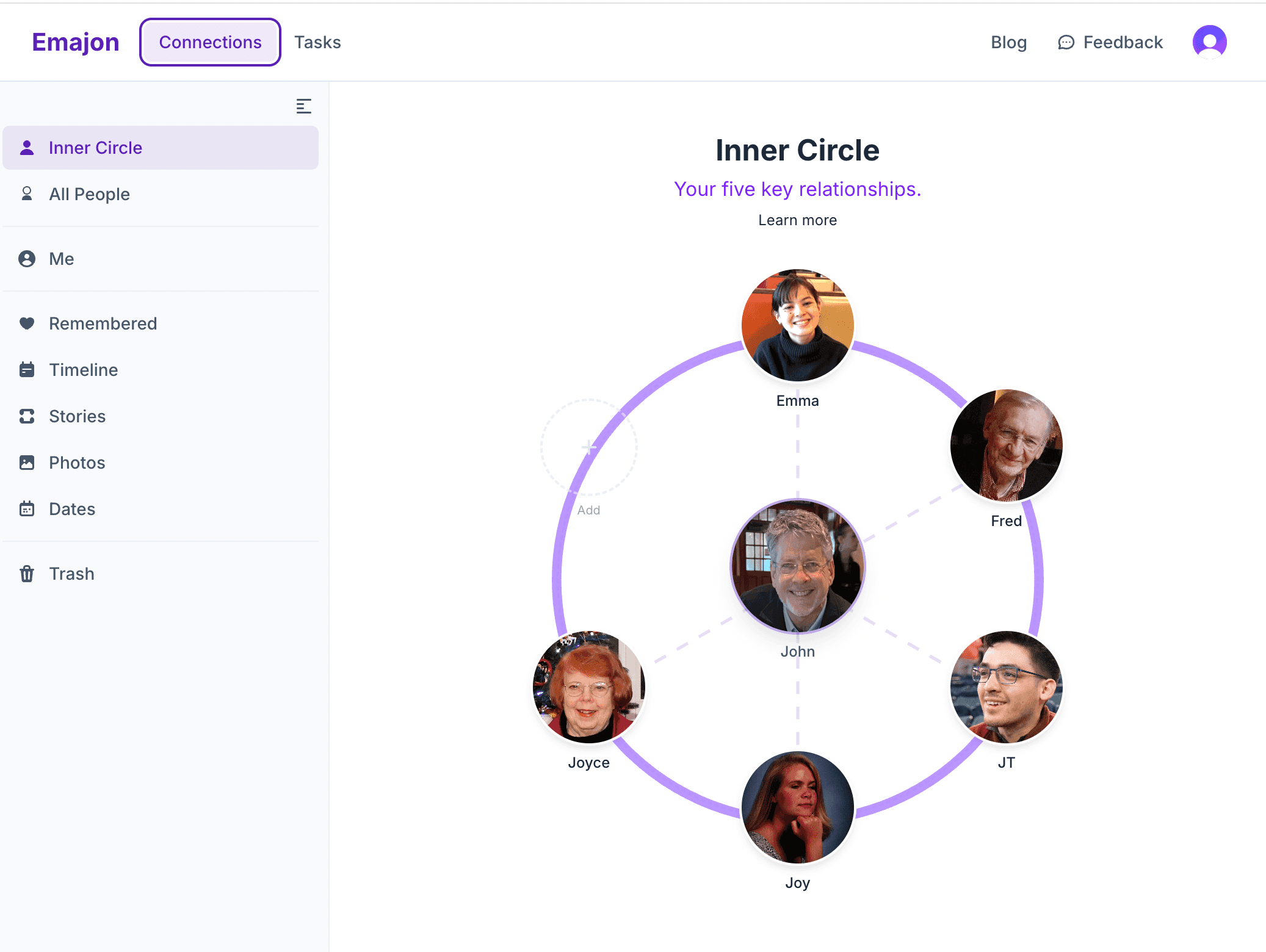
Your Five Key Relationships
How to use the Inner Circle in Emajon — adding people, enriching profiles, and the gentle nudges that help you stay connected.

Introducing Reconnect '26
Everyone has people who matter. Reconnect '26 is a practice — not a challenge — for closing the gap between how much you care and how often you connect.