The Power of "I Was Thinking About You"
Five words. That is all it takes.
"I was thinking about you."
No agenda. No catch-up plan. No obligation to have a long conversation. No need to explain where you have been or why it has been so long. Just: you crossed my mind, and I wanted you to know.
It is the simplest and most powerful act of connection there is. And if you have ADHD, it might be the single most important relationship skill you ever develop -- not because it is hard, but because it is so easy that your brain might actually let you do it.
Why These Five Words Matter So Much
You might assume that a quick "thinking of you" text is too small to matter. That after months of silence, a brief message would feel hollow or even unwelcome. That the other person has probably moved on, forgotten about you, or worse -- resents you for disappearing.
Your instincts about this are wrong. And we have the research to prove it.
In 2022, researchers Xuan Zhao and Nicholas Epley published a landmark series of studies in the Journal of Personality and Social Psychology examining what happens when people reach out to others unexpectedly. Across multiple experiments, they found a consistent and striking pattern:
People systematically and significantly underestimate how much others appreciate being contacted.
Here is what the research showed:
-
Recipients felt significantly more grateful, happy, and positively surprised than senders predicted. The people who received unexpected messages consistently rated the experience as more meaningful than the people who sent those messages expected it to be.
-
The longer it had been since last contact, the MORE the recipient appreciated hearing from them. This is the exact opposite of what guilt tells us. We assume that a longer gap makes reaching out more awkward. The data says a longer gap makes the message more valuable.
-
Even very brief, seemingly trivial reach-outs were valued far more than expected. You do not need to write a heartfelt letter. A two-line text counts. A meme with "this reminded me of you" counts. The bar is remarkably low.
-
The "underestimation gap" was largest for the contacts people felt MOST awkward reaching out to. The situations where we hesitate the most -- the friend we have not talked to in a year, the person we feel guilty about neglecting -- are precisely the situations where our message would be most appreciated.
Let that last finding settle for a moment. The people you feel most guilty about not contacting are the people who would be happiest to hear from you. The relationship between your guilt and reality runs in the opposite direction from what you assume.
Zhao and Epley's work builds on related research showing that we broadly underestimate the positive impact of expressing appreciation and care. A related study by Zhao and Epley found that people also underestimate how much others appreciate receiving compliments, creating a barrier that prevents us from expressing warmth we genuinely feel. The pattern is consistent: we hold back positive social gestures because we underestimate their impact, and in doing so, we deprive both ourselves and others of meaningful connection.
The implication is clear: every time your guilt says "it has been too long, they do not want to hear from me," the research says the opposite is true. Every time your anxiety whispers "they have probably forgotten about me," the data says your message would brighten their day more than you can imagine.
For ADHD Brains, This Is the Perfect Connection Act
If you have ADHD, maintaining relationships often feels like an impossible ask. Call your friend back. Schedule a lunch. Plan a visit. Remember their birthday. Follow up on that thing they mentioned. Each of these requires executive function -- planning, organizing, holding things in working memory, managing time -- and executive function is precisely what ADHD makes hard.
An ADDitude Magazine survey of 4,170 adults with ADHD found that 63% cited poor working memory and 57% cited executive dysfunction as root causes of their loneliness. The pattern is painfully familiar: you think about someone, intend to reach out, get distracted, and then suddenly it has been four months and the guilt is so heavy that reaching out feels impossible.
But "I was thinking about you" bypasses almost every barrier that ADHD creates. Here is why it works so well for brains like ours:
It requires almost zero executive function. There is nothing to plan, schedule, or coordinate. No logistics. No calendar juggling. No figuring out when you are both free. You just send a message.
It can be done in the moment. When you think of someone -- and you do think of people, probably more often than you realize -- you text them RIGHT THEN. Before working memory lets them slip away. Before the thought evaporates. The window is small for ADHD brains, and this act fits inside it.
It creates no commitment to a longer interaction. You are not promising a phone call. You are not suggesting a hangout. You are not opening a door that you then feel obligated to walk through. The message is complete in itself.
It carries low rejection risk. This matters enormously for people with rejection sensitive dysphoria. You are giving, not asking. There is no question to be rejected. You are offering a small gift of acknowledgment, not making a request that could be turned down.
It bypasses the guilt spiral entirely. You do not need to explain the gap. You do not need to apologize for going silent. You do not need to account for the months that have passed. The message itself communicates everything that matters: I think about you, and you matter to me.
It can be done from anywhere, in ten seconds. Standing in line at the grocery store. Waiting for your coffee. Sitting in your car before you go inside. The barrier to action is as low as it can possibly be.
It works via any channel. Text, voice memo, DM, email, even a postcard. Whatever medium involves the least friction for you in that moment is the right one.
For a brain that struggles with follow-through, planning, and the sustained effort of relationship maintenance, "I was thinking about you" is a gift. It is a complete, meaningful act of connection that fits inside the smallest window of attention and intention.
What It Signals to the Other Person
When someone receives an unexpected "I was thinking about you," what they hear goes far beyond those five words. The message carries layers of meaning that the sender often does not realize:
"I exist in your awareness." In a world where attention is the scarcest resource, knowing that someone spent even a moment of theirs thinking about you is profoundly affirming. It is the opposite of "out of sight, out of mind." It says: even when we are not together, you are present in my life.
"You matter to me enough that I acted on the thought." Everyone has fleeting thoughts about people they know. Most of those thoughts dissolve without action. When someone actually reaches out, it signals that the recipient occupies a meaningful place in the sender's inner world -- meaningful enough to move from thought to action.
"I am not reaching out because I need something." So much of our communication is transactional. We call when we need a favor. We text when we are making plans. We reach out when we want something. A message with no agenda, no ask, and no obligation communicates something rare: I am contacting you because you matter, not because you are useful.
"Our connection is alive, even if we have not talked in a while." Silence between friends can feel like death. Did the relationship end? Did I do something wrong? Are we still friends? An unprompted message answers all of these questions at once. The connection is not dead. It is just quiet. And quiet is okay.
For the friend of someone with ADHD -- someone who may have spent months wondering "do they even remember I exist?" -- these five words answer that question completely. Yes. You exist in my awareness. You matter. I thought about you, and I wanted you to know.
The ADDitude survey found that 65% of adults with ADHD cited rejection sensitive dysphoria as a root cause of their loneliness. Many of them are sitting right now with the assumption that their friends have given up on them. A single unexpected message can dismantle that assumption more effectively than any amount of self-talk.
Variations That Work Just as Well
"I was thinking about you" is the template, but it is not the only version. The principle is what matters: brief, genuine, zero-obligation. Here are variations that carry the same weight:
"Saw this and thought of you." Attach an article, a meme, a photo, a song, a recipe -- anything that connects to something you share. This version is especially easy for ADHD brains because the trigger is right in front of you. You see the thing, you think of the person, you forward it. Three seconds.
"Just remembered that time we [shared memory]. Made me smile." This one is powerful because it tells the recipient that your shared history is alive and present, not forgotten. It says: the things we did together mattered, and they still make me happy.
"Hey, how did [thing they mentioned last time] turn out?" This signals that you were paying attention and that you remember what matters to them. Even if your ADHD brain only retained one detail from your last conversation, following up on it communicates genuine care.
"No need to respond -- just wanted you to know you crossed my mind." This variation is a superpower, and we will come back to it in a moment.
A photo of something that connects to a shared experience. A picture of the restaurant you used to go to. A sunset that looks like one you watched together. The book they recommended that you finally started. No words needed -- the image does the work.
A voice memo. "Walking to the store and thought of you. Hope you are doing well." Voice memos carry warmth that text cannot. They let the recipient hear your voice, which activates a different and deeper sense of connection. And for ADHD brains, talking is often easier than typing.
The key across all of these: keep it brief, keep it genuine, and attach no strings. You are not opening a conversation unless the other person wants to. You are leaving a small gift on their doorstep and walking away.
The "No Need to Respond" Superpower
Of all the variations, adding "no need to reply" or "just wanted you to know" deserves its own section. These few extra words do something remarkable: they remove the reciprocity pressure entirely.
Here is what happens when most people receive an unexpected message from someone they have not heard from in a while. They feel a rush of warmth -- the research confirms this. But then, almost immediately, a second thought arrives: "I should respond. But what do I say? How do I match the energy of this? Should I apologize for not reaching out myself? I need to think about this..."
And then they put the phone down, intending to respond later. And later becomes tomorrow, and tomorrow becomes next week, and next week becomes a month, and now they are in their own guilt spiral about not responding to your message about thinking of them. The irony is almost unbearable.
"No need to respond" short-circuits this entire sequence. It gives the recipient permission to simply receive the gift. They can smile, feel the warmth, and move on. They do not have to figure out how to respond. They do not have to put off responding. They do not enter their own guilt spiral. You have given something with genuinely no strings attached.
This is especially powerful when both people have ADHD. Two ADHD brains trying to maintain a friendship can get stuck in a double guilt spiral: neither person reaches out because both feel guilty, and the silence compounds on both sides. A "thinking of you, no need to reply" message breaks the cycle from one side without creating pressure on the other.
It is also a quiet act of generosity. You are saying: I know that responding takes energy. I know that figuring out what to say can feel like work. I am not asking you to do that work. I just wanted to give you something good today.
Building the Habit (Without Making It a System)
If you have ADHD, the word "habit" might make you tense up. You have tried to build habits before. You have tried streaks, tracking apps, daily checklists, and accountability systems. Most of them worked for a week and then became another source of guilt when you inevitably dropped them.
This is not that.
"I was thinking about you" is not a habit you build through discipline. It is a practice you build through noticing. The thoughts are already happening -- you already think about people throughout your day. The only change is what you do in the moment after the thought arrives.
When someone crosses your mind, text them before the thought disappears. For ADHD brains, this is the critical instruction. The window between "I just thought of Sarah" and "what was I doing again?" can be measured in seconds. Act inside that window. Pick up your phone, type "hey, thinking of you," and hit send. Done. Do not compose the perfect message. Do not wait until you have more time. Do not tell yourself you will do it later. Later does not exist for working memory.
Keep it to one person at a time. Do not turn this into a project. You do not need to go through your entire contact list. You do not need to make sure everyone gets a message. If you think of one person today and text them, that is a complete success.
If the thought comes at 2am, draft the text and schedule-send it for morning. Your phone can do this. The thought is real and the impulse is genuine -- just delay the delivery so you are not the friend who texts at 2am. (Although honestly, some friends would love that too.)
Do not track it. Do not count how many people you have reached out to this week. Do not make a spreadsheet. Do not set a goal of "three people per week." The moment this becomes a metric, it stops being genuine and starts being a task. And tasks are what ADHD brains avoid.
Do not feel bad when you forget. You will have days, maybe weeks, where you think of no one. Or where you think of people and do not act on it. That is fine. This is not a streak to maintain. There is no streak to break. The next time a thought surfaces and you have ten seconds, you act on it. That is the whole practice.
The beauty of this approach is that it works with ADHD rather than against it. It does not require consistency. It does not require planning. It does not require remembering to do something at a specific time. It just asks you to notice what is already happening in your mind and, when the moment is right, take ten seconds to share it.
What About When You Are the One Who Never Gets These Messages?
This section is harder to write, but it matters.
If you have ADHD friends who go silent for months at a time, it is easy to start wondering whether they care. You reach out and hear nothing back. You invite them and they cancel. You share something important and get no response. After enough of these experiences, the conclusion feels obvious: they do not value the friendship the way you do.
But consider this: they might be thinking about you constantly and simply not acting on it. Working memory does not just make people forget -- it makes the gap between thought and action feel insurmountable. Your ADHD friend might think of you ten times a week and never once manage to convert that thought into a text. Not because you do not matter, but because the mechanism that connects intention to action is impaired.
The ADDitude survey data backs this up. When adults with ADHD were asked about the roots of their loneliness, 63% pointed to poor working memory and 57% to executive dysfunction. These are not people who have stopped caring. These are people whose brains struggle to translate caring into contact.
So here is something you can do: send the "thinking of you" message yourself. Your message might be the thing that breaks their guilt paralysis. It might be the evidence that counters the RSD narrative running in their head -- the one that says "they have probably given up on me by now." An unprompted message from you tells them: no, I have not given up. I am still here. The door is still open.
If you know they have ADHD, you might even add something like: "I know life gets busy. No need to respond. Just want you to know I am thinking about you." This tells them that you understand, that you are not keeping score, and that the friendship does not require perfect reciprocity to survive.
You cannot force someone to reach out. But you can make it easier for them to come back when they are ready. And sometimes, a single message is the bridge that makes that possible.
For people with ADHD who have not heard from friends in a while, rejection sensitive dysphoria often fills the silence with the worst possible interpretation: they are mad at me, they have replaced me, they do not care. Your unprompted message is not just a nice gesture -- it is a direct counter to a painful cognitive distortion. It is evidence. Real, tangible evidence that the friendship is still alive.
The Research, at a Glance
The ideas in this article are grounded in several lines of research:
On underestimating the impact of reaching out: Zhao, X. & Epley, N. (2022). Undervalued kindness: People underestimate the positive impact of reaching out to others. Journal of Personality and Social Psychology. This series of studies demonstrated that people consistently underestimate how much recipients value unexpected social contact, especially when more time has passed since the last interaction. A related paper by the same researchers -- "Insufficiently complimentary? Underestimating the positive impact of compliments creates a barrier to expressing them" (Journal of Personality and Social Psychology, 2022) -- found the same underestimation pattern for expressing appreciation more broadly.
On the power of weak ties and minimal social interactions: Sandstrom, G.M. & Dunn, E.W. (2014). Social Interactions and Well-Being: The Surprising Power of Weak Ties. Personality and Social Psychology Bulletin, 40(7), 910-922. This research demonstrated that even brief interactions with peripheral social contacts contribute meaningfully to daily wellbeing -- suggesting that small, low-effort connection acts carry real weight.
On ADHD, loneliness, and social barriers: ADDitude Magazine. The Loneliest Generation survey of 4,170 adults with ADHD. Key findings: 63% cite poor working memory and 65% cite rejection sensitive dysphoria as root causes of loneliness. 59% cite masking as a contributor. Nearly two-thirds of respondents ages 18-29 report feeling lonely "always" or "often."
Jong, A., Odoi, C.M., Lau, J., & Hollocks, M.J. (2024). Loneliness in Young People with ADHD: A Systematic Review and Meta-Analysis. Journal of Attention Disorders, 28(7), 1063-1081. This meta-analysis of 20 studies found that young people with ADHD experience significantly elevated loneliness compared to non-ADHD peers, with loneliness fully mediating the pathway from ADHD to depression.
Try It Today
Connection does not require grand gestures. It does not require perfect timing. It does not require making up for lost time or explaining where you have been. It does not require an hour-long phone call or a carefully planned visit. It does not require you to be a different, more organized, more consistent version of yourself.
It requires one small, genuine act: letting someone know they exist in your awareness.
Five words. Ten seconds. No agenda.
"I was thinking about you."
The research says they will be happier to hear from you than you expect. The research says the gap does not matter as much as you think. The research says that the friend you feel most guilty about neglecting is the one who would most appreciate your message.
Your ADHD guilt has been lying to you. The science is clear. They want to hear from you.
So try it. Right now, if you can. Think of one person. Just one. Someone who crossed your mind recently, someone you have been meaning to reach out to, someone you care about but have not contacted in a while.
Pick up your phone. Type five words. Hit send.
You will both be glad you did.
Stay in the Loop
New articles on money, health, and community — plus strategies for following through. No overwhelm, we promise.
Related Articles
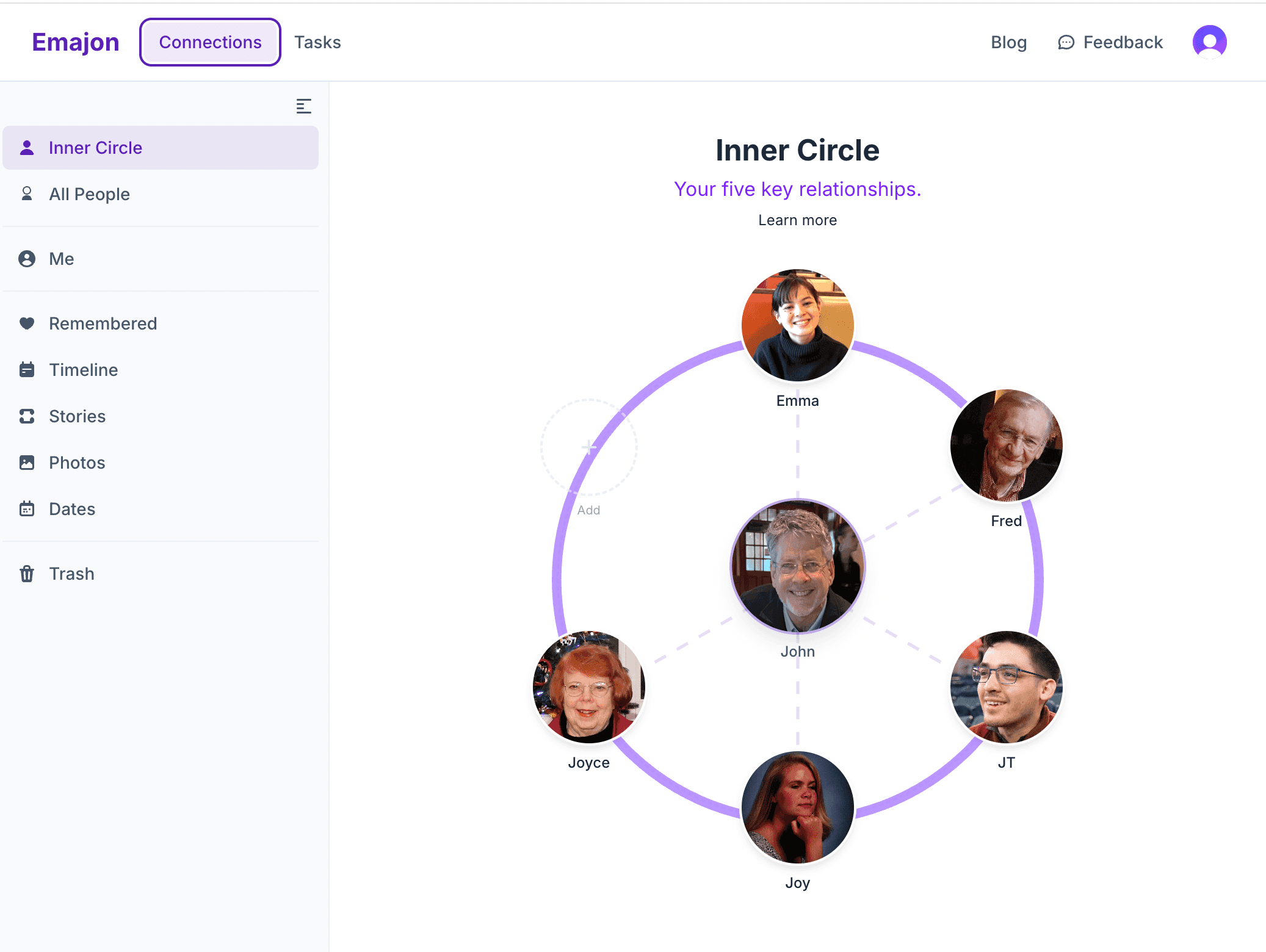
Getting Started with Emajon
A quick orientation for early testers — what Emajon is, how to navigate it, and why there's no wrong way to start.
Your Five Key Relationships
How to use the Inner Circle in Emajon — adding people, enriching profiles, and the gentle nudges that help you stay connected.

Introducing Reconnect '26
Everyone has people who matter. Reconnect '26 is a practice — not a challenge — for closing the gap between how much you care and how often you connect.