Why Every Personal CRM Misses the Point
The personal CRM market is booming. Valued at approximately $14.7 billion in 2025 and projected to reach $46 billion by 2035, relationship management software is one of the fastest-growing categories in personal productivity. Dex, Clay, Monica, Folk, Covve, UpHabit -- there is no shortage of tools promising to help you "manage your relationships."
And to be fair, these are not bad tools. Many of them are thoughtfully built, well-designed, and genuinely useful for the problems they set out to solve.
The issue is that they are solving the wrong problem.
The Networking Paradigm
Spend an hour with the major players in the personal CRM space and a clear pattern emerges. The language, the design, the features -- they all grow from the same root assumption: relationships are a professional asset to be optimized.
Dex bills itself as "a personal CRM that helps you build stronger relationships." In practice, its core workflow revolves around LinkedIn integration, professional networking, and a tagline vocabulary built around "nurturing your network." The relationships it helps you manage are the ones that might advance your career.
Clay promises to help you "remember everyone you've ever met." Its AI-powered contact enrichment pulls from your calendar, email, LinkedIn, and Twitter to build a comprehensive professional dossier on every person in your orbit. The positioning is explicit: professional relationship intelligence. It is a powerful tool for people who need to maintain large professional networks -- consultants, investors, salespeople, founders.
Folk takes the collaborative route. Pipeline views, team-oriented workflows, shared contact databases. It is, functionally, Salesforce for your contacts. Useful if your team needs to coordinate outreach. Less useful if you are trying to remember your best friend's kid's name.
Covve layers news alerts and smart reminders on top of your contact list. Its orientation is professional: stay informed about what is happening in your contacts' careers so you can reach out at the right moment. The "right moment," in this framing, is when there is a professional reason to.
Monica comes closest to what is actually needed. It is open source, privacy-first, and explicitly oriented toward personal relationships rather than professional ones. It includes journaling, gift tracking, and life event logging. But its interface feels dated, its development pace is limited by a small team, it was not designed with neurodivergent users in mind, and it offers no AI assistance or physical-world integration.
The pattern across the category is unmistakable. The language is borrowed wholesale from sales CRMs: contacts, pipelines, follow-ups, nurturing, engagement. The mental model is the same one that powers HubSpot and Salesforce, scaled down for individual use.
Your friends are not leads.
What This Framing Gets Wrong
The networking paradigm treats relationships as instrumentally valuable. Maintain your network because it is useful -- for career advancement, deal flow, professional opportunities, introductions, referrals. The implicit promise is ROI: invest time in your relationships and they will pay dividends.
This framing is not wrong for professional contexts. If you are a venture capitalist or a recruiter, a tool that helps you track 2,000 professional contacts and surface the right one at the right moment is genuinely valuable. That is a real problem with a real market.
But the loneliness crisis is not about professional networking gaps.
The U.S. Surgeon General declared loneliness a public health epidemic. The WHO estimates 871,000 deaths per year are linked to social disconnection. Fifty-seven percent of Americans report being lonely. The health risks of chronic loneliness rival smoking 15 cigarettes a day.
People are not lonely because they forgot to follow up with a business contact. They are lonely because they have not talked to their best friend in four months and feel too guilty to call. They are lonely because they moved to a new city and the effort of building friendships from scratch feels insurmountable. They are lonely because life got busy and the people who matter most quietly slipped out of their daily awareness.
No pipeline view fixes that. No LinkedIn integration addresses it. The personal CRM category has identified a real need -- relationships require intentional maintenance -- but has packaged the solution in a framework designed for salespeople, not for people who are struggling to stay connected to the humans they love.
The ADHD Gap
For the estimated 8-10% of adults living with ADHD, the mismatch between existing tools and actual needs is even more stark.
An ADDitude Magazine survey of 4,170 adults with ADHD found that 63% cite poor working memory as a root cause of their loneliness. Fifty-seven percent cite executive dysfunction and disorganization. These are not minor inconveniences -- they are the core mechanisms through which ADHD erodes friendships.
Working memory is the cognitive system that keeps information active and accessible. When it works well, people you care about stay present in your awareness even when they are not physically in front of you. When it does not -- as is the case with ADHD -- people you love literally disappear from your active consciousness. Not because you stopped caring. Because your brain's system for maintaining awareness of things outside your immediate environment does not work the way the world assumes it does.
This is the "out of sight, out of mind" problem, and it is devastating. Months pass without contact. Guilt accumulates. The longer the gap, the harder it becomes to reach out. Eventually, the relationship atrophies -- not from lack of love, but from lack of a cognitive system that most tools assume you have.
None of the existing personal CRMs are designed for this specific cognitive profile:
- They assume consistent daily use. ADHD engagement is bursty -- intense periods of activity followed by extended absence. Tools that expect daily check-ins lose ADHD users within the first week.
- They rely on the user initiating actions. ADHD needs proactive prompting. The whole point is that the person cannot reliably remember to open the app and do the thing.
- They punish gaps. Overdue follow-ups. Broken streaks. Red notification badges. For someone whose defining challenge is inconsistency, every one of these is a message that says: you failed again.
- They require complex setup before delivering value. Import your contacts, configure your settings, build your pipelines, customize your tags. ADHD brains need instant payoff. A tool that requires 30 minutes of setup before it does anything useful will be abandoned in 5.
- They do not account for working memory. The entire "out of sight, out of mind" problem -- the single most important factor in ADHD friendship loss -- is not addressed by any existing tool in a meaningful way.
The Emotional Safety Gap
This one is subtle, but it may be the most important gap of all.
Current personal CRMs use language and design patterns that, for many users -- and especially those with ADHD and Rejection Sensitive Dysphoria -- do not motivate. They paralyze.
Consider the common design patterns:
- "Overdue" follow-ups. The word "overdue" carries an implicit judgment: you were supposed to do this and you did not. You have failed.
- Red notification badges. Red means danger, error, something wrong. A red "3" on your relationship app does not feel like a helpful reminder. It feels like an accusation.
- "You haven't contacted X in 47 days." This is a guilt counter. It quantifies exactly how much of a bad friend you have been. The number only goes up.
- Relationship "scores" or "health" metrics. Your friendships are now graded. You are getting a C- in being a good friend. The data confirms what you already feared.
- Streaks. Maintain your streak by reaching out every week. Miss once and the counter resets to zero. Your 47-day streak is gone. Start over.
For someone with Rejection Sensitive Dysphoria -- the intense emotional pain triggered by perceived failure or criticism that affects an estimated 65% of adults with ADHD -- these patterns are not motivational tools. They are confirmation of the internal narrative that already runs on repeat: I am a bad friend. I always let people down. Everyone would be better off without me.
The result is predictable. The person opens the app, sees the red badges and the overdue counters and the declining relationship scores, feels a wave of shame, closes the app, and does not open it again. The tool designed to help them maintain relationships has instead reinforced the emotional pattern that prevents them from maintaining relationships.
The Physical World Gap
Every personal CRM is phone-first or web-first. On the surface, this makes sense -- your phone is always with you, and a web app is accessible from anywhere.
But for ADHD brains, the phone is arguably the worst possible relationship tool. It is engineered -- at the operating system level, by every app on it, by the entire attention economy -- to fragment your focus. Opening your phone to check your relationship app means navigating past notifications, social media, news alerts, and a dozen other attention traps. The odds of completing the intended action without getting derailed are low.
No existing CRM bridges to the physical world. None of them integrate with paper cards, desk reminders, or physical artifacts that persist in your environment without demanding attention.
This is not nostalgia. Previous generations had address books, calling cards, Christmas card lists -- physical objects that provided ambient visibility into their relationships. You did not have to remember to check your address book. It sat on your desk, and its presence was a passive reminder that people existed. The photo on your mantle of your college friends was not a notification. It was just there, part of the environment, gently keeping those people in your awareness.
We digitized everything and lost the ambient visibility that physical objects provide. For a brain that loses awareness of anything not in its immediate environment, this loss is particularly damaging.
The Authenticity Gap
Networking tools optimize for maintaining the largest possible network. More contacts, more connections, more reach. The implicit goal is breadth.
But the research tells a different story. Robin Dunbar's decades of work on social network structure shows that humans can maintain approximately 150 meaningful relationships, organized in concentric layers: an inner circle of about 5 intimate confidants, a close group of about 15, an active network of about 50, and a broader circle of about 150. A 2025 study published in PLoS ONE confirmed that people intuitively allocate substantially more social energy to their inner layers, and that this total "social bandwidth" is relatively fixed -- investing more in some relationships necessarily means investing less in others.
The question, then, is not "how do I manage 2,000 contacts?" It is "how do I make sure I do not lose touch with the 15 people who matter most?"
Quantity optimization misses the point entirely. A tool that helps you maintain a vast professional network but does not help you notice that your closest friend has been drifting away for six months is solving the wrong problem. The relationships most worth maintaining are the ones closest to you -- and those are precisely the ones that professional CRMs treat as unremarkable. There is no deal to close, no career opportunity to pursue. There is just a person you love who you have not called.
The Intervention Gap
A 2025 meta-analytic review of 280 loneliness studies, published in American Psychologist, found something that should reshape how we think about relationship tools. Among all intervention types studied, psychological interventions -- specifically cognitive reframing, changing how people think about their social connections -- produced the largest effect size (d = -0.79). This was substantially more effective than social skills training, social support programs, or simply increasing social contact opportunities.
The most effective way to reduce loneliness is not to give people more social events to attend. It is to help them change how they think about their relationships.
No personal CRM incorporates this insight. None of them help you reframe "I am a terrible friend who always lets people down" into "my brain works differently, and the gap between my intentions and my actions is not a moral failing -- it is an executive function challenge that I can build systems around." None of them help you recognize that your friend will probably be happy to hear from you, even after months of silence. None of them gently challenge the catastrophic thinking that RSD generates.
They are tools, not interventions. They manage contacts. They do not help you think differently about the people those contacts represent.
What a Relationship Tool Actually Needs to Be
If the personal CRM category has the right instinct -- that relationships need intentional support in a world that no longer provides natural structures for maintaining them -- but the wrong execution, what would the right execution look like?
Not a CRM. Not a networking tool. A relationship support system. The distinction matters.
Designed for inconsistent use patterns. The tool works whether you use it every day or once a month. When you come back after a long absence, it catches you up instead of punishing you for being gone. It expects inconsistency and designs around it.
Emotionally safe. No guilt. No shame. No scores. No overdue counters. No red badges. The language is warm and the design assumes you are doing your best. When it surfaces a friend you have not spoken to in a while, the tone is "here is someone you might want to reconnect with," not "you have neglected this relationship."
Proactively surfaces people fading from awareness. Instead of waiting for you to remember, the system notices when someone important is drifting out of your active life and gently brings them back to your attention. This is the externalization of working memory -- the single most impactful feature a relationship tool could provide for someone with ADHD.
Bridges digital and physical worlds. Paper cards on your desk. Physical artifacts that keep people visible in your environment. A system that does not require you to be staring at a screen to benefit from it. Technology that pushes you toward real-world connection rather than substituting for it.
Frames relationships as inherently valuable. Not as a professional asset. Not as a network to optimize. As a fundamental human need that deserves support for its own sake. The reason to call your friend is not because they might be useful to your career. It is because they are your friend and hearing their voice will make both of you feel more alive.
Supports authentic connection over polished networking. The goal is not to help you seem impressive to a wide audience. It is to help you be real with the people who matter. To say "I have been thinking about you but ADHD makes it hard to reach out" rather than crafting the perfect professional check-in.
Helps you think differently, not just manage more efficiently. Incorporates what the research actually shows works: cognitive reframing, permission-giving, challenging the catastrophic social thinking that keeps people isolated. A tool that says "your friend will be glad to hear from you -- studies show people consistently underestimate how much others appreciate unexpected contact" is doing something no current CRM does.
Built for the brain you actually have. Not the idealized brain that remembers to check in consistently, processes notifications rationally, and never feels shame about a gap in contact. The real brain -- distractible, inconsistent, sensitive, and deeply capable of love even when it struggles with the logistics of showing it.
The Gap Remains
The personal CRM category has identified something real: in a world without the village, the church, the neighborhood, the office -- all the structures that used to create natural, recurring opportunities for connection -- relationships need intentional maintenance. The market is growing because the need is genuine and urgent.
But the execution is stuck in a networking paradigm that serves salespeople better than it serves lonely people. The tools optimize for breadth when depth is what matters. They assume consistent use from brains that are anything but consistent. They borrow the language of sales when they should be speaking the language of care. They measure and score when they should reassure and support. They live entirely in the digital world when the physical world is where human connection actually happens.
The $46 billion market projection tells us the demand is there. The loneliness epidemic tells us the stakes are real. The research tells us what actually works. The gap between what exists and what is needed remains wide open -- not because no one has tried, but because almost everyone who has tried started from the same flawed premise.
Relationships are not a network to be managed. They are a practice to be supported. Until a tool starts from that understanding, the point will keep being missed.
References
-
Future Market Insights. (2025). Personal CRM Market Size & Trends 2025-2035. https://www.futuremarketinsights.com/reports/personal-crm-market
-
ADDitude Magazine. The Loneliest Generation: ADHD and the Epidemic of Isolation and Withdrawal. https://www.additudemag.com/isolation-withdrawal-loneliness-epidemic-adhd/
-
Dunbar, R. (2024). The social brain hypothesis -- thirty years on. Annals of Human Biology. https://www.tandfonline.com/doi/full/10.1080/03014460.2024.2359920
-
Wlodarski, R. et al. (2025). Reflecting on Dunbar's numbers: Individual differences in energy allocation to personal relationships. PLoS ONE. https://pmc.ncbi.nlm.nih.gov/articles/PMC11896044/
-
Eccles, A.M. et al. (2025). Are loneliness interventions effective? A meta-analytic review of 280 studies. American Psychologist. https://pubmed.ncbi.nlm.nih.gov/41129341/
-
Wave Connect. (2025). 6 Best Personal CRM Tools in 2025. https://wavecnct.com/blogs/news/the-6-best-personal-crm-tools-in-2025
-
U.S. Surgeon General. (2023). Our Epidemic of Loneliness and Isolation. https://www.hhs.gov/surgeongeneral/reports-and-publications/connection/index.html
-
World Health Organization. (2025). Commission on Social Connection. https://www.who.int/groups/commission-on-social-connection
-
Jong, A. et al. (2024). Loneliness in Young People with ADHD: A Systematic Review and Meta-Analysis. Journal of Attention Disorders, 28(7), 1063-1081. https://pmc.ncbi.nlm.nih.gov/articles/PMC11016212/
-
Zhao, X. & Epley, N. (2022). Underestimating the value of reaching out. Journal of Personality and Social Psychology. https://doi.org/10.1037/pspi0000402
Stay in the Loop
New articles on money, health, and community — plus strategies for following through. No overwhelm, we promise.
Related Articles
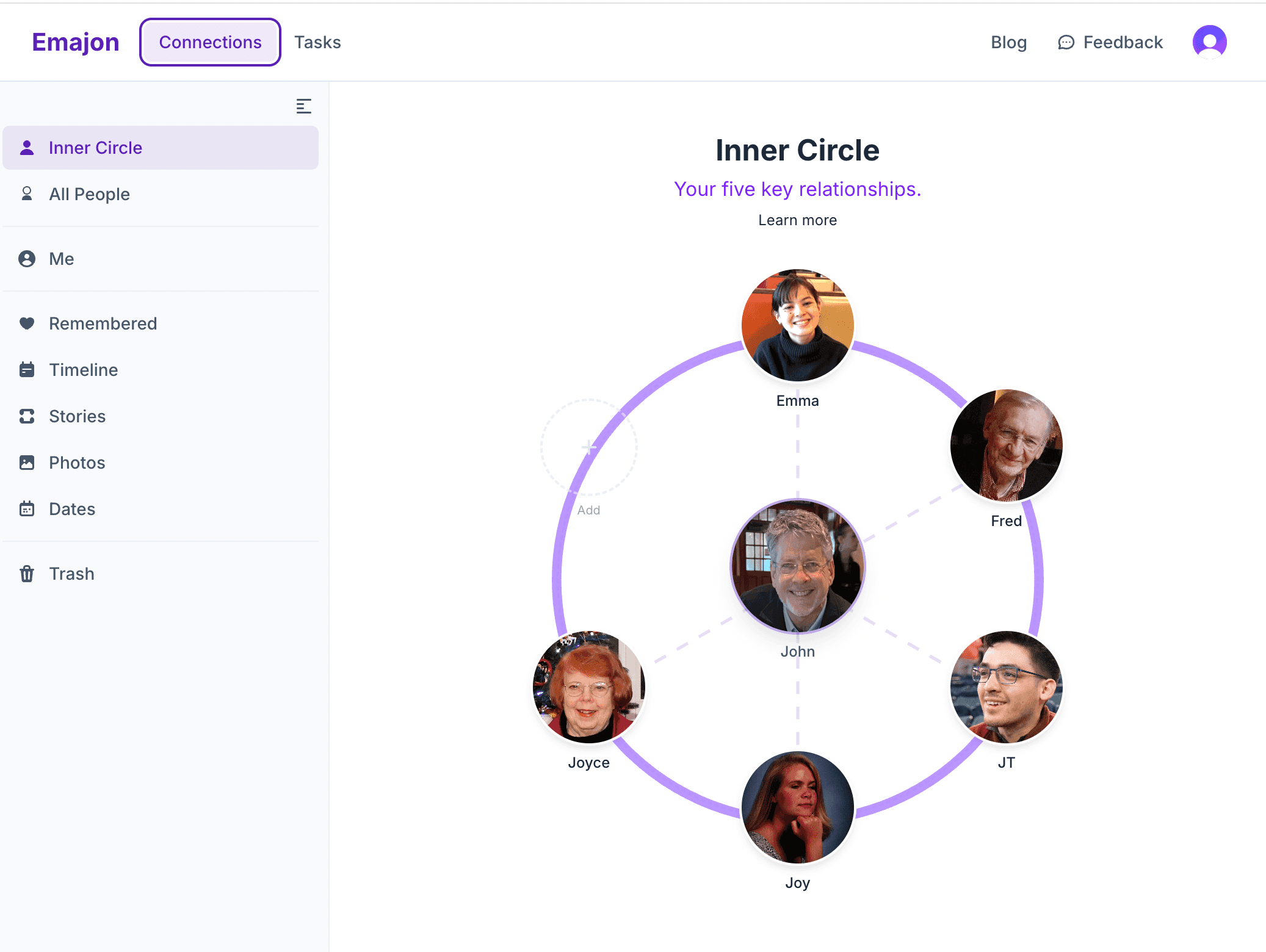
Getting Started with Emajon
A quick orientation for early testers — what Emajon is, how to navigate it, and why there's no wrong way to start.
Your Five Key Relationships
How to use the Inner Circle in Emajon — adding people, enriching profiles, and the gentle nudges that help you stay connected.

Introducing Reconnect '26
Everyone has people who matter. Reconnect '26 is a practice — not a challenge — for closing the gap between how much you care and how often you connect.