Why "Just Put Yourself Out There" Doesn't Work
You've heard it. You've probably heard it a hundred times.
"Just put yourself out there."
Join a club. Go to events. Download an app. Say yes more. Be more social. Try harder. It sounds so simple, so obvious, so reasonable. And for millions of people -- especially those with ADHD -- it fails completely.
Not because they're not trying. Not because they're not motivated. Not because they don't want connection badly enough.
It fails because the advice itself is based on a fundamental misunderstanding of what causes loneliness.
If you've ever forced yourself to show up at a social event, endured an evening of small talk, driven home feeling more alone than when you arrived, and then blamed yourself for doing it wrong -- this article is for you. You weren't doing it wrong. You were following advice that was never designed for the actual problem.
The Assumption Behind the Advice
"Put yourself out there" rests on a simple assumption: loneliness is caused by insufficient social contact. Lonely people aren't meeting enough people. They aren't attending enough events. They aren't creating enough opportunities for connection. If you just increase the inputs -- more people, more events, more exposure -- the loneliness will resolve.
Call it the "more social opportunities" theory of loneliness intervention.
It's intuitive. It feels logical. And it's not entirely wrong -- social contact does matter. But it treats loneliness like an empty room that just needs more furniture. Show up to enough places, meet enough people, and eventually the room fills up.
The problem is that for most lonely people, the room isn't empty. The room is full of furniture they can't sit on. The barriers to connection aren't about access. They're about what happens inside your head when connection is available.
What the Research Actually Shows
In 2025, researchers published the largest meta-analytic review of loneliness interventions ever conducted. Spanning 280 studies, the review appeared in American Psychologist and examined what actually works to reduce loneliness across the lifespan.
The results challenged the conventional wisdom profoundly. Here's what they found, organized by the type of intervention:
| Intervention Type | Effect Size | What It Includes | |---|---|---| | Psychological interventions | -0.79 (largest) | Cognitive behavioral therapy, cognitive reframing, addressing maladaptive social cognition | | Social interaction-based | -0.50 (medium) | Structured group activities, shared interest groups, facilitated socializing | | Social support-based | -0.34 (moderate) | Peer support, buddy systems, mentoring programs | | Social skills training | Smallest effect | Teaching conversation skills, social cue reading, assertiveness |
Read that again. The single most effective approach to reducing loneliness is not providing more social opportunities. It's changing how people think about social connection.
Psychological interventions -- the ones that address cognitive distortions, negative beliefs about social interactions, and maladaptive patterns of social thinking -- produced an effect size of -0.79. That's nearly 60% larger than providing more social interaction opportunities, and more than double the effect of social support programs.
The finding was echoed by a separate rapid systematic review of 101 loneliness interventions, also published in 2025 in the Journal of Public Health Policy. That review confirmed that interventions combining psychological strategies with social opportunities were most effective, and that simply increasing social contact without addressing the psychological barriers produced weaker results.
The key finding across both analyses: the most effective loneliness interventions address what researchers call "maladaptive social cognition" -- the distorted beliefs about how others perceive you, whether you belong, and what will happen if you try to connect.
In other words, the biggest barrier to connection isn't a lack of opportunities. It's the stories your brain tells you about what other people think of you.
Why More Socializing Can Actually Make It Worse
Here's the part that nobody talks about: for some people, "putting yourself out there" doesn't just fail to help. It actively makes things worse.
This is especially true for people with ADHD, where the standard advice collides with neurological reality at almost every point.
More social events means more executive function demands
Every social event requires planning (where, when, how to get there), initiating (actually starting the process of getting ready), time management (showing up when you're supposed to), and sustained attention (following conversations, remembering names, tracking social dynamics). For people with ADHD, every one of these is a site of potential failure. The advice to "go to more events" is, functionally, advice to place more demands on the cognitive systems that are already your weakest.
More interactions means more opportunities for perceived rejection
Rejection Sensitive Dysphoria (RSD) -- the experience of severe emotional pain triggered by perceived rejection -- affects a significant portion of adults with ADHD. In a survey of 4,170 adults with ADHD conducted by ADDitude Magazine, 65% cited RSD as a root cause of their loneliness. When every social interaction carries the possibility of a perceived slight -- a text not returned, a joke that doesn't land, a conversation that seems to lose energy -- more interactions don't reduce the fear. They multiply it.
Masking in new social situations is exhausting
Masking -- suppressing your natural behaviors and adopting neurotypical patterns to fit in -- is a survival strategy that many neurodivergent people employ in social situations. In the same ADDitude survey, 59% of adults with ADHD cited masking as a root cause of their loneliness. The cruel irony: the very strategy that gets you through social events is the one that prevents genuine connection. You show up. You perform. You go home exhausted. And the person everyone met wasn't really you.
Socializing while lonely can reinforce negative beliefs
This might be the most important point. When you're already carrying beliefs like "nobody actually wants me there" and you force yourself to attend an event, your brain is primed to find evidence for those beliefs. The person who didn't approach you. The conversation that felt stilted. The moment you lost track of what someone was saying. Each one becomes confirmation: See? I went out and still felt alone.
This isn't hypothetical. Eighty-nine percent of young adults with ADHD in the ADDitude survey reported feeling lonely even when around other people. For these individuals, "just put yourself out there" isn't a solution. It's a setup for a loneliness experience so painful that it makes future attempts even harder.
Even active social media engagement doesn't help
You might think that at least digital socializing would be easier -- lower stakes, less executive function demand, more control over the interaction. But a 2025 study from Baylor University found that both passive and active social media use are associated with increased loneliness over time. Not just scrolling. Active posting, commenting, and engaging. The researchers identified what they called an "authenticity-visibility paradox": as users become more visible online, they present less authentic versions of themselves, undermining the very connection they're seeking.
Only 19% of adults with ADHD say social media makes them feel more connected. For the other 81%, it's noise at best, and a loneliness amplifier at worst.
The Real Barriers to Connection
If the problem isn't a lack of social opportunities, what is it?
The research -- and the lived experience of millions of people -- points to a set of internal barriers that no amount of "putting yourself out there" can address.
Maladaptive social cognition
"Nobody actually wants me there." "I'm a burden." "They're just being polite." "They probably didn't even notice I was gone." These aren't feelings. They're predictions -- predictions your brain makes about other people's internal states. And for most lonely people, these predictions are systematically wrong. But they feel absolutely real, and they shape behavior in powerful ways. You don't reach out because you "know" the other person doesn't want to hear from you. You don't go to the event because you "know" you won't be welcome. The air quotes matter. These aren't facts. They're the output of a pattern-recognition system that has been calibrated by years of real or perceived social pain.
Rejection Sensitive Dysphoria
RSD takes maladaptive social cognition and amplifies it to unbearable intensity. The fear of rejection isn't just a mild concern -- it's experienced as a kind of emotional emergency that overrides rational thought. The Cleveland Clinic describes it as intense, overwhelming emotional responses to real or perceived rejection that are disproportionate to the triggering event. When the potential cost of rejection feels this catastrophic, avoidance becomes the only logical strategy. Not reaching out isn't laziness. It's self-preservation.
Working memory deficits
Here's something that people without ADHD rarely understand: when someone with ADHD doesn't call you for four months, it's not because they don't care about you. It's because you literally disappeared from their active awareness. Working memory -- the system that keeps things present and accessible in your mind -- is impaired in ADHD. People you love can vanish from your mental landscape the moment they're not physically in front of you. You think about them when something reminds you of them. But the spontaneous "I should call Sarah" that neurotypical people experience simply doesn't fire reliably. In the ADDitude survey, 63% of adults cited poor working memory as a root cause of their loneliness.
Energy depletion from masking
If you've spent eight hours at work monitoring your every behavior -- sitting still enough, not interrupting, tracking conversations, managing your facial expressions, suppressing the urge to blurt out the perfect joke at the wrong moment -- you have nothing left for genuine connection at the end of the day. The people who need authentic social connection the most are often the people with the least energy to pursue it. Masking all day leaves nothing for the evening. Nothing for the weekend plans. Nothing for the text that would only take thirty seconds but feels like it weighs a hundred pounds.
The guilt spiral
You think about your friend. You remember you haven't called. You feel guilty about the gap. The guilt makes the call harder, not easier, because now you'd have to explain the silence. More time passes. More guilt. The gap becomes an abyss. Eventually: "It's been too long. I can't reach out now."
This is possibly the most destructive cycle in ADHD friendship, and every step of it is driven by cognition, not by a lack of social opportunity.
All-or-nothing thinking
"I can't do the full social thing -- the getting ready, the driving there, the small talk, the two-hour commitment, the performing -- so I'll do nothing." When the perceived cost of participation is high and executive function resources are depleted, the brain defaults to the simplest option: opt out entirely. This isn't a failure of motivation. It's a rational response to an irrational demand, filtered through a brain that struggles with partial engagement.
What Cognitive Reframing Actually Looks Like
If psychological interventions are the most effective approach, what does that mean in practice? It's not just "think positive." It's a specific set of skills for interrogating the stories your brain tells you about social situations.
Recognizing thoughts as thoughts, not facts
"They don't want to hear from me" is a thought. It feels like a fact. It arrives with the certainty of a fact. But it's a prediction generated by your brain's threat-detection system, not a piece of verified information. The first step in cognitive reframing is learning to notice the difference -- to catch yourself treating a prediction as a conclusion.
Understanding your brain's systematic bias
If you have RSD, your brain's prediction of social rejection is not a neutral assessment. It's systematically biased toward the worst-case interpretation. Knowing this doesn't make the feelings go away, but it does give you a reason to question them. "My brain is telling me they don't want to hear from me. My brain also tells me this about everyone, including people who have repeatedly demonstrated that they care. Maybe this is the RSD talking."
Reframing silence
"They haven't called" is a data point. Your brain's interpretation -- "because they don't care" -- is a story. An equally valid story: "They're probably dealing with their own stuff, just like I am." For people with ADHD, this reframe is especially powerful, because you know what it's like to care about someone and not call. You do it constantly. Extending that same understanding to others is both more accurate and more compassionate.
Evidence-gathering
When the thought "reaching out will go badly" arrives, ask: "What actually happened last time I reached out?" Not what your brain predicted would happen. What actually happened.
In most cases, the answer is: it went fine. They were happy to hear from you. The conversation was easy. You felt better afterward. Your brain's prediction track record for social catastrophe is, in all likelihood, terrible. But you've never checked the data, because the prediction was so convincing you acted on it without testing it.
The research on reaching out
Psychologists Peggy Zhao and Nicholas Epley have studied this exact phenomenon. Their research found that people consistently and significantly underestimate how much others appreciate being reached out to. The gap between how much you think someone will appreciate an unexpected message and how much they actually appreciate it is large and reliable. Your friend will be glad to hear from you. The hesitation is coming from inside the house.
What Actually Works Instead
If "put yourself out there" is the wrong advice, what's the right advice? Based on the research, here's what actually helps.
Address the thinking first
Before you try to change your social behavior, work on the beliefs that make connection feel dangerous. This might mean formal therapy (more on that below), or it might mean practicing the cognitive reframing skills on your own. But the sequence matters. If you try to increase social contact without addressing the maladaptive cognitions that make social contact feel threatening, you're pushing a boulder uphill. If you address the cognitions first, the social contact becomes easier naturally.
Lower the bar
The "minimum viable friendship" is real. Research suggests that even minimal, infrequent contact can sustain a meaningful relationship -- as long as it's genuine. A text counts. A meme counts. A voice memo counts. "Thinking of you" counts. You don't have to schedule a two-hour dinner to maintain a friendship. The bar is lower than you think, and lowering it further -- deliberately, consciously -- reduces the executive function demand and makes action more likely.
You don't have to be perfect. You just have to be present, even briefly, even imperfectly.
Choose environments that reduce masking
Not all social environments are created equal. Some demand constant performance. Others allow you to exist as yourself. Neurodivergent communities -- online or in person -- are consistently cited as spaces where masking isn't necessary. More than half of adults in the ADDitude survey said they relate better to, and feel less lonely around, other neurodivergent adults. As one respondent put it: "In a neurodivergent group, I don't feel weird, and I can let my mask slip. It is less taxing and there is less of a chance of me freaking out later over social mistakes I might have made."
Beyond neurodivergent-specific spaces, look for environments that involve parallel play -- doing something together rather than facing each other in conversation. Activity-based socializing (board game nights, hiking groups, art classes, cooking together, working side by side) reduces the pressure of sustained face-to-face interaction. The activity provides structure, fills silences, gives you something to focus on, and lets connection happen naturally as a byproduct rather than as the explicit goal.
Small groups are better than large ones. Familiar settings are better than new ones. And any environment where you can be direct, honest, and a little bit weird without penalty is worth its weight in gold.
Build structure, not willpower
Willpower is a terrible tool for relationship maintenance. It's unreliable, depletable, and especially scarce for people with ADHD. Structure is the alternative.
Recurring events are better than spontaneous plans. A standing Tuesday lunch is something your calendar handles. "We should get together sometime" is something your working memory is supposed to handle -- and it won't.
Automated reminders to check in on someone aren't cold or impersonal. They're an external system doing the job that working memory can't. The reminder is the scaffold. The warmth comes from you.
The principle is simple: anything you can externalize -- the remembering, the scheduling, the initiating -- removes a point of failure between your genuine care for someone and the action that expresses it. Structure doesn't replace the human element. It makes room for it.
Start with existing relationships
The standard advice assumes you need to go find new people. But for most people struggling with loneliness -- especially ADHD-related loneliness -- the problem isn't a shortage of people who care about them. It's a failure to maintain contact with people who already do.
You probably don't need new friends. You need to reconnect with the ones you already have. The friend you haven't called in six months. The family member you've been meaning to text. The colleague who always seemed to enjoy talking to you. These relationships are dormant, not dead. And reviving a dormant relationship is almost always easier than building a new one from scratch.
Remember the Zhao and Epley research: people underestimate how much others appreciate being reached out to. That friend you're afraid to call? They'll probably be relieved to hear from you.
A Note About Therapy
The 2025 meta-analysis makes something clear: the most effective loneliness interventions are psychological ones. Specifically, approaches like Cognitive Behavioral Therapy (CBT) and Dialectical Behavior Therapy (DBT) have evidence for addressing the cognitive patterns that maintain loneliness -- the maladaptive beliefs, the distorted predictions, the avoidance cycles.
This matters, and it's worth saying directly: if the research identifies maladaptive social cognition as the primary barrier to connection, then working on your social cognition with a professional isn't a sign of weakness. It's using the most effective tool the research has identified. It's the equivalent of wearing glasses because you can't see clearly. The problem is in the processing system, and the solution is in the processing system too.
For people with ADHD specifically, a therapist who understands the intersection of ADHD, RSD, and loneliness can help you distinguish between cognitive distortions that need reframing and genuine executive function gaps that need external support. Both are real. Both are addressable. They just require different tools.
If therapy isn't accessible right now, that's okay. The cognitive reframing skills described in this article can be practiced independently. The important thing is to recognize that the work isn't "go to more parties." The work is "change what you believe about what happens when you go to a party."
You Don't Need to Put Yourself Out There More
Let's be honest about what "just put yourself out there" really says. Beneath its cheerful surface, it carries an implication: you're lonely because you're not trying hard enough. If you just made more effort, you'd have the connections you want.
That implication is wrong. And for people who have been trying -- who have dragged themselves to events, endured the small talk, faked the energy, and driven home feeling hollowed out -- it's not just wrong. It's cruel.
The research is clear. The biggest barrier to connection isn't opportunity. It's the stories our brains tell us about what other people think of us. It's the prediction that we'll be rejected. The conviction that we're a burden. The certainty that the silence means they've moved on. For ADHD brains, those stories are louder, more vivid, and more convincing than they are for most people. Rejection Sensitive Dysphoria makes the fear feel like fact. Working memory deficits make the people we love disappear from our awareness. Executive function gaps turn good intentions into missed connections. And masking ensures that even when we do show up, we're not really there.
But here's the thing about stories: they can be rewritten.
Not with more social events. Not with more forced smiles at networking mixers. Not with another app download.
With the slow, patient work of noticing what your brain tells you about connection, questioning whether it's true, and discovering -- usually -- that it isn't.
You don't need to put yourself out there more. You might need to change what you believe about what happens when you do.
And if that sounds like a lot of work, consider this: the 280-study meta-analysis says it's the single most effective thing you can do. More effective than joining clubs. More effective than social skills training. More effective than any "just be more social" strategy ever devised.
Your brain has been telling you a story about why connection is dangerous. The research says: that story is the problem. And changing the story is the solution.
References
-
Are loneliness interventions effective? A meta-analytic review of 280 studies. American Psychologist (2025). https://pubmed.ncbi.nlm.nih.gov/41129341/
-
What works to reduce loneliness: A rapid systematic review of 101 interventions. Journal of Public Health Policy / PMC (2025). https://pmc.ncbi.nlm.nih.gov/articles/PMC12119363/
-
Jong, A., Odoi, C.M., Lau, J., & Hollocks, M.J. (2024). Loneliness in Young People with ADHD: A Systematic Review and Meta-Analysis. Journal of Attention Disorders, 28(7), 1063-1081. https://pmc.ncbi.nlm.nih.gov/articles/PMC11016212/
-
ADDitude Magazine. The Loneliest Generation: ADHD and Social Isolation Survey (4,170 adults). https://www.additudemag.com/isolation-withdrawal-loneliness-epidemic-adhd/
-
Baylor University (2025). Social Media's Double-Edged Sword: Study Links Both Active and Passive Use to Rising Loneliness. https://news.web.baylor.edu/news/story/2025/social-medias-double-edged-sword-study-links-both-active-and-passive-use-rising
-
Zhao, X., & Epley, N. (2022). Surprisingly happy to have helped: Underestimating prosociality creates a misplaced barrier to asking for help. Psychological Science; see also Zhao, X., & Epley, N. (2021). Insufficiently complimentary? Underestimating the positive impact of compliments creates a barrier to expressing them. Journal of Personality and Social Psychology.
-
Cleveland Clinic. Rejection Sensitive Dysphoria (RSD): Symptoms and Treatment. https://my.clevelandclinic.org/health/diseases/24099-rejection-sensitive-dysphoria-rsd
Stay in the Loop
New articles on money, health, and community — plus strategies for following through. No overwhelm, we promise.
Related Articles
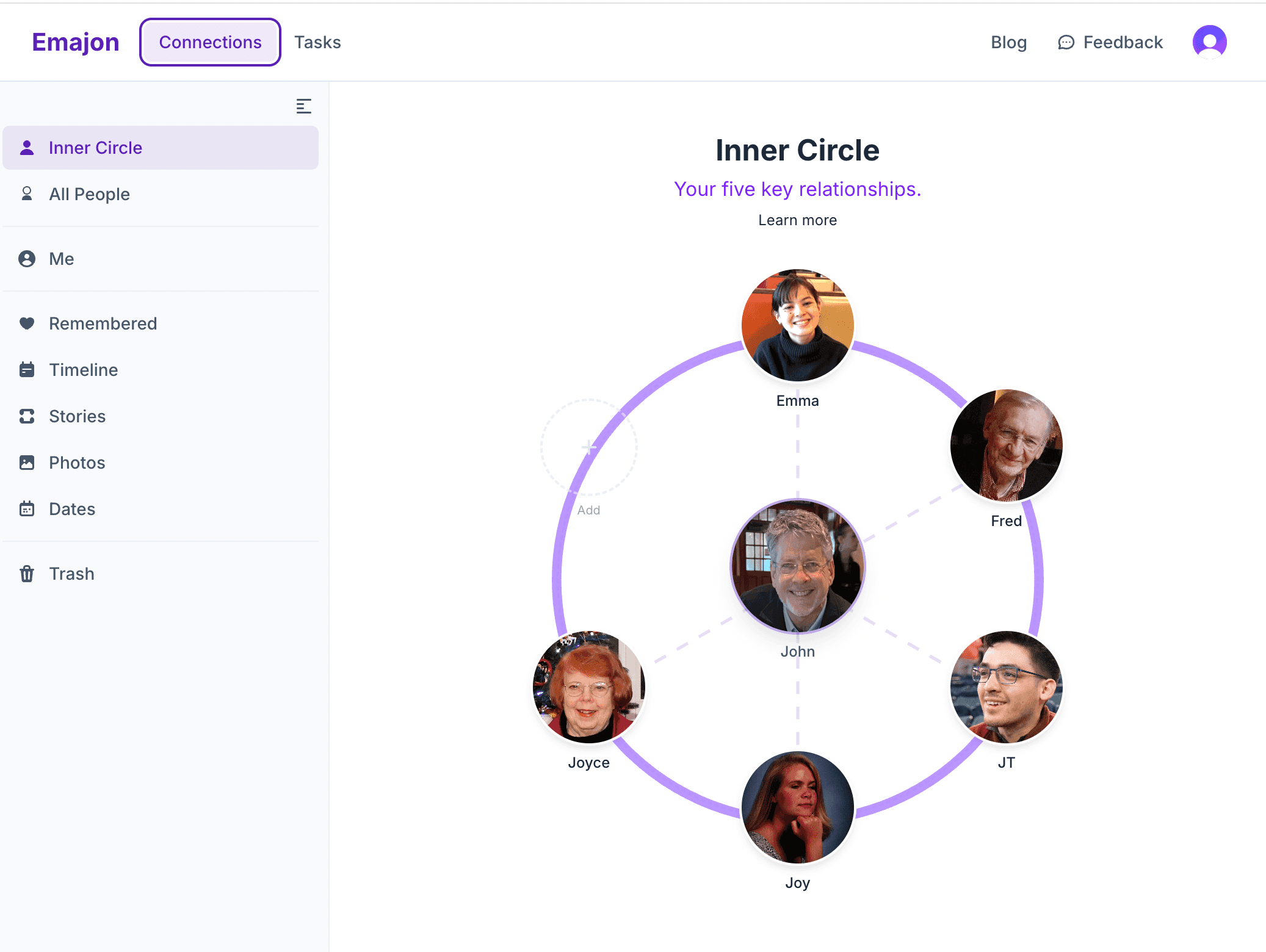
Getting Started with Emajon
A quick orientation for early testers — what Emajon is, how to navigate it, and why there's no wrong way to start.
Your Five Key Relationships
How to use the Inner Circle in Emajon — adding people, enriching profiles, and the gentle nudges that help you stay connected.

Introducing Reconnect '26
Everyone has people who matter. Reconnect '26 is a practice — not a challenge — for closing the gap between how much you care and how often you connect.