Why We're Building This (A Personal Story)
The Slow Fade
I found the text thread in March. I was scrolling through my messages looking for a restaurant recommendation someone had sent me, and I landed on a conversation with my friend David. The last message was from him: "Yeah man, let's definitely do that. Maybe the weekend after next?"
That message was from September. Seven months earlier.
I stared at it for a while. I could feel the warmth of the conversation even through the screen — we'd been talking about getting together for a hike we used to do regularly, a trail we'd walked dozens of times in the years after college when we lived twenty minutes apart. It was an easy yes from both of us. The kind of plan that should have happened.
It didn't happen. Not because something went wrong. Not because we had a falling out or a disagreement. Not because either of us moved away or got too busy in some dramatic, life-altering way. It didn't happen because after I read his message, I put my phone down to do something else — I don't even remember what — and his message dropped out of my awareness entirely. Like it had never existed.
Seven months. I hadn't thought about David — hadn't actively, consciously thought about him — for seven months. Not because he doesn't matter to me. He does. He was one of my closest friends for years. He knows things about me that most people don't. I was in his wedding. He helped me move twice. The kind of friend you call when something real happens, good or bad.
But I didn't call. I didn't text. I didn't think to. And sitting there in March, staring at that seven-month gap, I felt the thing that every person with ADHD who reads this will recognize immediately: the shame. Not mild embarrassment. Shame. The deep, full-body kind that says you are the kind of person who forgets the people who matter to them.
I typed out a message. Deleted it. Typed another one. Deleted that too. What do you say after seven months of silence? "Hey, sorry I disappeared"? That sounds dramatic. "What's up?" feels hollow after that much time. The longer I sat with it, the harder it got to send anything at all.
So I closed the app. And I didn't text David that day either.
A Pattern, Not an Incident
If it were just David, I could explain it away. People get busy. Life gets complicated. Friendships go through seasons.
But it wasn't just David.
A few weeks after that moment, I did something I'd been avoiding for a long time. I scrolled through my entire contact list — slowly, name by name. Not the professional contacts or the people I interact with out of necessity. The people I actually care about. Friends. Family. People who have been part of my life in meaningful ways.
I started keeping a mental count. How long since I'd talked to each person? Not exchanged a like on social media. Not been in the same group chat where someone posted a meme. Actually talked. Had a conversation that mattered.
The count was devastating.
My college roommate — over a year. My cousin who I grew up spending every summer with — eight months. A friend who'd supported me through one of the hardest periods of my life — I couldn't remember the last time we'd spoken. Three friends from a group that used to get together monthly — the group text had been silent since the previous spring.
These are people I love. People I think about. If you'd asked me on any given day whether these relationships mattered to me, I would have said yes without hesitation. I carry them with me — their stories, their humor, the way they see the world. They are present in my inner life in a way that feels real and ongoing.
But my inner life and my actual behavior had been completely disconnected. In my mind, I was a person who cared deeply about his relationships. In practice, I was a person who hadn't reached out to most of the people he cared about in months. Some in over a year.
And the worst part — the part that still gets me — is that I hadn't noticed. The time had passed without any alarm bells. There was no moment where I thought, "It's been three months since I talked to David, I should call him." The thought simply never arose. He existed in my life the way a book exists on a shelf — present, valued, but not in my hands. Not active.
I know the word for this now. It's called time blindness. The inability to feel the passage of time intuitively, to sense that weeks and months are accumulating. For most people, time has a texture — three days feels different from three months. For me, and for millions of people like me, it doesn't. The last conversation with David felt recent. It felt like it had just happened. Seven months had the same emotional weight as seven days.
Naming the Thing
I was diagnosed with ADHD as an adult. The diagnosis came later than it should have, as it does for so many people — especially those who did well enough in structured environments like school to fly under the radar. I was the kid who got good grades but couldn't find his homework. The teenager who had a messy room but could argue philosophy for hours. The adult who could hyperfocus on a project for twelve straight hours but couldn't remember to pay a bill that was sitting on the counter in front of him.
When the diagnosis came, it was like getting subtitles for a movie I'd been watching my whole life. Suddenly, patterns that had seemed random or moral — I'm lazy, I'm careless, I'm selfish — had a mechanical explanation. My brain works differently. Specifically, the systems responsible for executive function — working memory, planning, prioritization, time awareness — operate differently in my brain than in a neurotypical brain.
This isn't an excuse. It's a description. The distinction matters.
Working memory is the mental workspace where you hold information you're actively using. It's what keeps you aware that you need to pick up milk on the way home, that your friend mentioned a job interview last week, that your mom's birthday is coming up. In ADHD, working memory is impaired. Not absent — impaired. Things fall out of active awareness faster and more completely than they do for other people.
This means that when something isn't directly in front of me — when a person isn't physically present, when a task isn't staring me in the face — it doesn't just fade into the background. It can effectively disappear. Not from my long-term memory. Not from my feelings. From my active awareness. The part of my mind that generates the thought, "Hey, I should reach out to David."
Neurotypical brains run a kind of background process for relationships. It's subtle and mostly unconscious — a quiet hum in the back of the mind that keeps track of people, notices when too much time has passed, generates the impulse to check in. ADHD brains don't run that process reliably. The hum cuts out. The reminder never fires. And because you don't notice the absence of a thought you didn't have, you don't realize anything is wrong until the evidence is undeniable — a seven-month gap in a text thread, a birthday you missed, a friendship that has quietly starved.
Getting the diagnosis changed the shame. It didn't eliminate it — I'm not sure anything fully does — but it reframed it. The story shifted from "I'm a bad person who doesn't care about the people in my life" to "I have a specific neurological difference that makes certain aspects of relationship maintenance genuinely harder for me." That's not a free pass. I still have to figure out how to maintain my relationships. But at least I'm solving the right problem now. I'm not trying to become a better person through sheer willpower. I'm trying to build systems that compensate for a specific cognitive gap.
The Numbers Behind the Feeling
For a long time, I thought this was just my problem. My specific flavor of brokenness. Then I started reading the research.
In May 2023, the U.S. Surgeon General issued a landmark advisory declaring loneliness and isolation a public health epidemic. Not a trend. Not a concern. An epidemic. The advisory laid out data that stopped me cold: half of American adults experienced measurable loneliness even before the pandemic. Young people aged 15 to 24 had 70% less social interaction with friends compared to twenty years prior. Time spent alone had increased by 24 hours per month. Time spent with friends had declined by roughly 20 hours per month in the same period.
The World Health Organization followed in 2025, establishing its first-ever Commission on Social Connection. Their finding: one in six people worldwide are affected by loneliness. An estimated 871,000 deaths annually are linked to it. That is approximately 100 deaths per hour — from loneliness. The health impact is equivalent to smoking 15 cigarettes a day.
I sat with those numbers for a while. This was not a personal failing. This was a structural crisis.
And then I found the research that hit even closer to home.
In February 2024, researchers at King's College London published the first meta-analysis specifically examining loneliness in young people with ADHD. They reviewed 20 studies involving approximately 6,300 participants. The finding: young people with ADHD experience significantly higher loneliness than their non-ADHD peers, with a small-to-medium effect size (Hedges' g = 0.41). When one outlier study was removed, the effect increased to 0.48.
But the finding that stopped me — the one that changed how I thought about everything — was this: loneliness fully mediated the relationship between ADHD diagnosis and depression. Fully mediated. That means loneliness isn't just a side effect of ADHD. It's the pathway. ADHD makes you lonely. Loneliness makes you depressed. Address the loneliness, and you may break the chain.
ADDitude Magazine surveyed 4,170 adults with ADHD and found that nearly two-thirds of respondents aged 18 to 29 reported feeling lonely "always" or "often." Eighty-nine percent felt lonely even when around other people. The most commonly reported roots of that loneliness included poor working memory (63%), rejection sensitive dysphoria (65%), and masking who they really are (59%).
Reading this data felt like reading a clinical description of my own life. The working memory failures that let friendships atrophy. The rejection sensitivity that made it agonizing to reach out after a gap — they probably don't want to hear from me; it's been too long; I'm a burden. The masking that made social interactions exhausting instead of nourishing.
This wasn't just me. This was millions of people. And the research was pointing, loudly and clearly, at a problem that nobody was building the right thing to solve.
Looking for a Tool That Didn't Exist
So I went looking. I tried every personal CRM on the market. Dex. Clay. Monica. Covve. I read every review, watched every demo, signed up for every trial.
They're all built for networking.
The language gives it away immediately. "Manage your network." "Nurture your leads." "Follow up with prospects." "Build strategic relationships." The entire category is designed for people who want to optimize their professional contacts — who want to remember which venture capitalist they met at which conference and when to send a follow-up email to close a deal.
I don't need to manage my network. I need to remember to call my mom.
I don't have leads to nurture. I have a best friend whose kid just started kindergarten and I missed it because my brain didn't remind me that September means the school year is starting and maybe I should check in.
I don't want to optimize my strategic relationships. I want to be the kind of person who remembers that his cousin is going through a hard time and sends a text that says, "Thinking about you."
Every tool I tried made me feel worse, not better. The dashboards with their completion percentages and engagement scores. The red indicators showing how many contacts I'd "neglected." The streak mechanics tracking consecutive days of outreach. All of it designed for a neurotypical brain running a productivity optimization framework. All of it implicitly saying: you're not doing enough. You're falling behind. Look at all these people you're failing.
For someone with ADHD — someone who already carries years of shame about dropped relationships and forgotten commitments — this kind of interface isn't motivating. It's devastating. It's the digital equivalent of someone showing you a list of every friend you've let down and asking why you can't try harder.
I closed every one of those apps and didn't go back.
What If the Tool Was Built for a Brain Like Mine?
The question started as frustration and turned into something else. A design problem. A real one.
What if a tool existed that was built from the ground up for the way my brain actually works? Not adapted. Not accommodated. Built for it.
What if it assumed inconsistency instead of punishing it? My engagement with any system is irregular — intense bursts followed by periods of absence. Every productivity app I've ever used punishes this pattern with broken streaks, guilt notifications, and "you haven't logged in for 5 days!" messages. What if a tool expected this pattern and designed for it? What if coming back after a gap felt like a warm welcome, not a reprimand?
What if it never used guilt, streaks, or scores? No "relationship health score" that drops when I don't reach out. No streak counter that resets to zero and makes me feel like I've failed. No comparative metrics showing how much better other people are at this than me. What if the tool's only emotional register was support?
What if it externalized the executive function that friendship requires? My brain doesn't reliably run the background process that says, "Hey, it's been a while since you talked to David." What if a system ran that process for me? Not nagging. Not demanding. Just gently surfacing the right person at the right time: You mentioned wanting to check in with David. He's probably free this evening. Or: Sarah's birthday is next week. Last year you sent her that book she loved. The kind of gentle, context-aware prompting that a good friend with a perfect memory might offer.
What if it treated relationships as inherently valuable, not instrumentally useful? Not "nurture this contact because they could be useful to your career." Just: "This person matters to you. Here's what you know about them. Here's a way to show them that."
What if it helped you be a good friend without making you feel like a bad one?
These questions pointed toward something specific. A set of design principles began to emerge: reduce friction to zero, so the distance between thinking of someone and reaching out is as short as possible. Make the right thing visible at the right time, because out of sight is literally out of mind. Respect the attention budget — never spend my attention without earning it. Support inconsistency as a feature, not a bug. Externalize executive function so the system does the cognitive work my brain struggles with. Provide emotional safety above all else — the tool should never, under any circumstances, make someone feel worse about themselves. Design for hyperfocus too, because when I'm engaged, I'm deeply engaged, and the system should protect that state. And always, always encourage living in the real world — because the goal isn't more screen time. The goal is more human connection.
Why Paper Matters
Here's an irony that anyone with ADHD will recognize: the device that contains all of my contacts — every phone number, every text thread, every way to reach the people I care about — is also the single most effective attention-destruction machine ever engineered.
When I pick up my phone to text David, I have to navigate past notifications, past the home screen full of app badges, past the pull of social media and news and the thousand small dopamine traps that are specifically designed to capture exactly the kind of distractible attention that defines my brain. I pick up the phone to reach out to a friend. Fourteen minutes later, I've watched three videos, checked two apps, and forgotten why I picked up the phone in the first place.
This is not a willpower problem. This is an environment design problem. The phone is hostile territory for the intent to connect.
So what if some of this could happen without a screen?
A card on your desk with Sarah's name on it. Not a notification that flashes and disappears. A physical object that sits in your environment, quietly reminding you that Sarah exists, that she matters, that you've been meaning to check in. Something you see when you sit down with your coffee in the morning. Something that doesn't compete with Instagram for your attention because it doesn't live in the same device as Instagram.
This isn't nostalgia for a pre-digital world. This is cognitive science. Physical objects persist in your environment in a way that digital notifications cannot. A notification arrives, gets swiped away, and is gone. A card on your desk stays there until you pick it up. For a brain that operates on "out of sight, out of mind," physical persistence isn't a nice-to-have — it's a lifeline.
There's something deeper here too. The act of writing a note on a card after a conversation — David mentioned he's training for a half marathon, his daughter just lost her first tooth — engages different cognitive pathways than typing into an app. Tactile interaction aids memory. Writing by hand slows you down just enough to process what you're recording. And a stack of cards for the people you care about — a physical, tangible artifact of your relationships — has a weight and reality that a database never will.
The phone is the right tool for some things. Communication across distance. Scheduling. Quick messages. But it's the wrong tool for the quiet, ambient awareness of who matters to you and what's happening in their lives. For that, paper might be better. Not instead of digital. Alongside it. A bridge between the two worlds, where each medium does what it does best.
Three Pillars of a Life
As I sat with all of this — the research, the personal experience, the design questions — a larger picture started to form.
Loneliness and connection were the entry point. But the underlying challenge is broader. There are three dimensions to a well-lived life that are all profoundly underserved for neurodivergent people: community, health, and finance.
Community — the relationships and social bonds that give life meaning. Health — the physical, mental, and behavioral wellness that sustains you. Finance — the stability and awareness that lets you live without constant anxiety about money.
All three are areas where executive function matters enormously. All three are areas where ADHD creates specific, identifiable, and addressable challenges. And all three are areas where existing tools are designed for neurotypical brains operating in ideal conditions.
But community comes first. The research is unambiguous about this. The Jong meta-analysis showing that loneliness fully mediates the ADHD-to-depression pathway tells us something profound: connection is not one piece of the puzzle. It's the foundation. Fix the relationships, and other things begin to improve. Lose the relationships, and everything else gets harder.
That's why we're starting here. Not because health and finance don't matter. They do, deeply. But because connection is the ground everything else is built on. A person who feels seen, known, and connected has a foundation for addressing everything else. A person who is isolated is fighting every battle alone.
What Emajon Is (and What It Isn't)
Emajon is the thing I went looking for and couldn't find.
It is a tool that helps you maintain the relationships that matter to you — designed specifically for brains that struggle with the maintenance mechanics. Not the caring. Not the love. The mechanics. The remembering, the reaching out, the following up, the keeping track of what's happening in someone's life when they're not standing in front of you.
It is built on research, not engagement metrics. Every design decision is informed by what we know about ADHD, loneliness, working memory, rejection sensitivity, and evidence-based interventions. We don't optimize for time-in-app. We optimize for time-with-people.
It is a bridge between digital and physical connection. Digital tools manage and scale knowledge — your contacts, your notes, your reminders, the context that makes your relationships deeper. Physical tools — cards, objects, things that persist in your environment — support the ambient awareness that digital can't replicate. Both are first-class parts of the system.
It is not a social network. We don't want your attention. We want you to give it to your people. There are no feeds, no algorithms, no strangers, no ads. The only people in Emajon are the people you've chosen to have in your life.
It is not a productivity tool dressed up as a relationship tool. We don't use the language of professional networking. We don't talk about nurturing leads or managing your network. We talk about remembering your mom's birthday and checking in on a friend who's going through a hard time. These are different things, and they deserve a different tool.
It is not AI replacing human connection. AI can externalize executive function — it can remember, surface context, gently prompt, and reduce friction. AI should not automate your relationships. The goal is never for the system to reach out on your behalf. The goal is for the system to make it so easy for you to reach out that the only thing standing between you and the people you care about is the genuine, human desire to connect — which, for most of us, was never the problem. The problem was always the machinery between the desire and the action.
Building Where You Can See Us
We're building Emajon in public. Not because transparency is trendy — though it doesn't hurt — but because it's the only approach that makes sense for what we're trying to do.
If we're building something for people who feel unseen, the least we can do is be visible ourselves. If we're building something for a community, the community should be part of building it.
That means sharing the journey: the design decisions and the reasoning behind them. The trade-offs we're making and why. The research that's guiding us and where the evidence is uncertain. The mistakes we're going to make — because we will — and what we learn from them.
It also means listening. The seven articles that came before this one weren't just content. They were the beginning of a conversation. We wrote about the ADHD friendship problem, about working memory and relationships, about rejection sensitive dysphoria, about why existing tools miss the point. And the responses to those pieces — the messages, the comments, the people sharing their own stories — have already changed how we think about what we're building.
We need that to continue. If you've lived this experience, if you know what it feels like to love someone and forget to show it, if you've scrolled through your contacts and felt the gut-punch of how much time has passed — your story matters. Your experience is data that no academic study can fully capture. And we want to build something that actually works for you, not something that works for a theoretical user who exists only in a product spec.
So follow along. Tell us what resonates and what doesn't. Share the moments that made you feel seen and the moments where we got it wrong. This thing doesn't get built right in a vacuum.
Why This, Why Now, Why Me
I want to be honest about something. I'm not building Emajon because I identified a market opportunity and decided to exploit it. I'm not building it because some business school framework told me the timing was right. I'm building it because I need it.
I'm building it because I'm tired of being the person who thinks about his friends and doesn't call them. Because I'm tired of the shame spiral — the guilt that builds the longer I wait, the anxiety that makes the next contact harder, the silence that compounds until the relationship has quietly, without drama, died.
I'm building it because the research tells me this problem is solvable. Working memory can be externalized. Executive function can be supported by well-designed systems. The cognitive gaps that make relationship maintenance hard for ADHD brains are specific and addressable — not through willpower, not through trying harder, but through tools that do the cognitive work our brains struggle to do on their own.
I'm building it because the right tool doesn't exist yet. I know — I looked. I tried everything. And everything I tried was designed for someone else, solving a different problem, measuring success by the wrong metrics.
And I'm building it because every day this tool doesn't exist, millions of people are losing connections they'll wish they'd maintained. Every day, someone with ADHD looks at a text thread and sees a gap measured in months and feels that same shame I felt looking at David's message. Every day, a friendship that both people value is quietly atrophying — not from conflict, not from loss of affection, but from the simple, mechanical failure of a brain that doesn't send the reminder signal at the right time.
The Surgeon General's advisory called loneliness an epidemic. The WHO called it a pressing global health threat. The meta-analysis showed that ADHD and loneliness are deeply, structurally linked. The ADDitude survey showed that two-thirds of young adults with ADHD are lonely always or often. The research on interventions shows that the most effective approach is changing how people think about connection and reducing the practical barriers to maintaining it.
That's what we're building. A system that changes the story from "I'm a bad friend" to "I have support for being the friend I already want to be." A system that externalizes the executive function, bridges the digital and physical worlds, and never — not once, not ever — makes you feel worse about yourself than you did before you opened it.
If any of the previous articles in this series resonated with you — if you've felt the guilt, the shame, the silent atrophy of friendships you care about — then this is being built for you. And for me. Because I need it too.
I texted David, by the way. It took me another three weeks after that moment in March, but I did it. I said something simple: "I was thinking about you. I'm sorry it's been so long. That's on me." He wrote back in four minutes. He said he'd been meaning to reach out too. We went on that hike the following Saturday.
The gap didn't matter as much as I thought it would. It almost never does. The hard part was never the conversation. The hard part was remembering to start one.
That's the part I'm building help for.
References
-
Jong, A., Odoi, C.M., Lau, J., & Hollocks, M.J. (2024). Loneliness in Young People with ADHD: A Systematic Review and Meta-Analysis. Journal of Attention Disorders, 28(7), 1063-1081. https://pmc.ncbi.nlm.nih.gov/articles/PMC11016212/
-
U.S. Surgeon General (2023). Our Epidemic of Loneliness and Isolation: The Healing Effects of Social Connection and Community. https://www.hhs.gov/surgeongeneral/reports-and-publications/connection/index.html
-
World Health Organization (2025). Commission on Social Connection. https://www.who.int/groups/commission-on-social-connection
-
ADDitude Magazine. The Loneliest Generation: ADHD and the Epidemic of Loneliness. https://www.additudemag.com/isolation-withdrawal-loneliness-epidemic-adhd/
-
AARP (2025). Disconnected: The Escalating Challenge of Loneliness Among Adults 45-Plus. https://www.aarp.org/pri/topics/social-leisure/relationships/loneliness-social-connections-2025/
Stay in the Loop
New articles on money, health, and community — plus strategies for following through. No overwhelm, we promise.
Related Articles
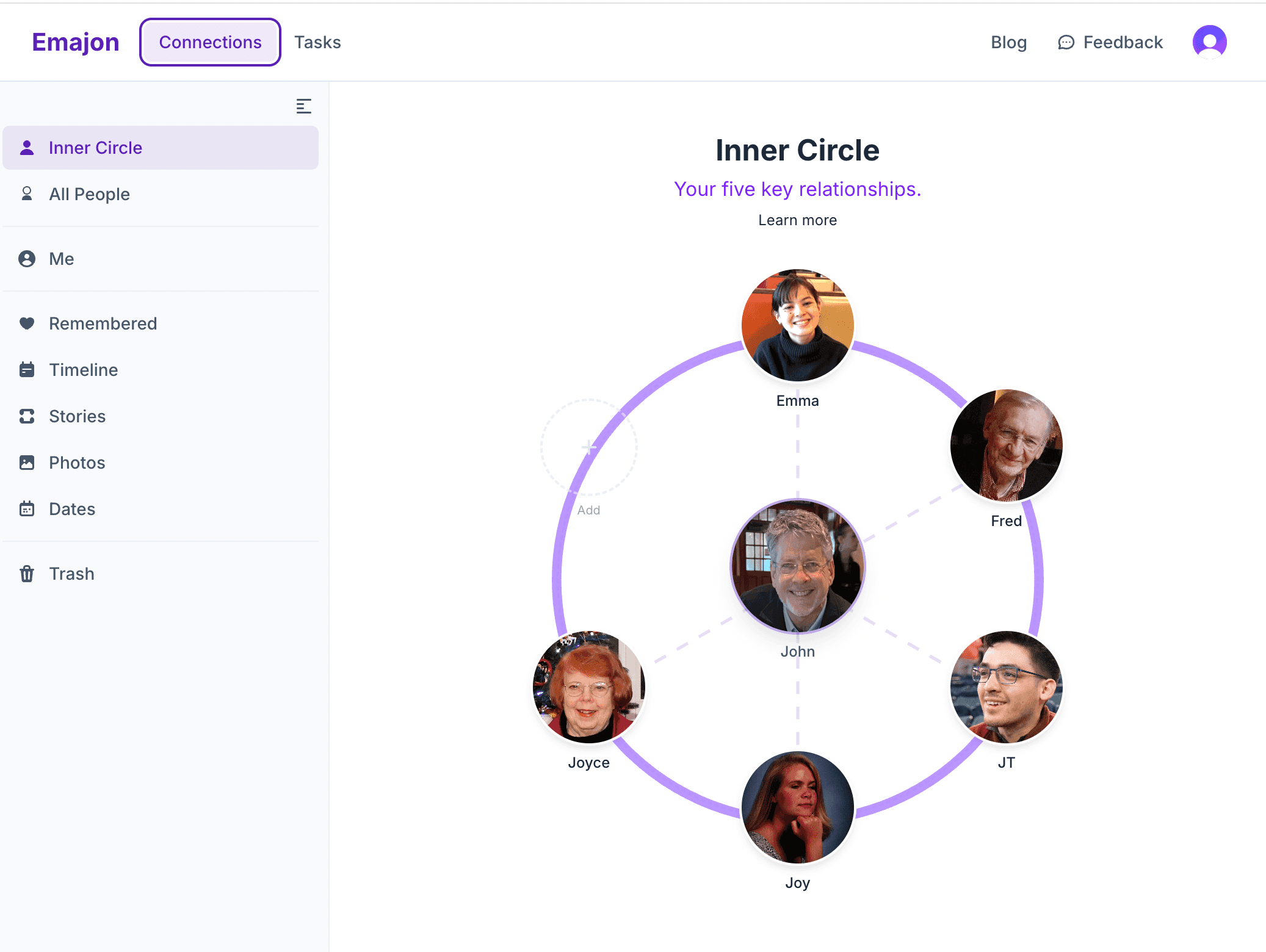
Getting Started with Emajon
A quick orientation for early testers — what Emajon is, how to navigate it, and why there's no wrong way to start.
Your Five Key Relationships
How to use the Inner Circle in Emajon — adding people, enriching profiles, and the gentle nudges that help you stay connected.
Introducing Reconnect '26
Everyone has people who matter. Reconnect '26 is a practice — not a challenge — for closing the gap between how much you care and how often you connect.